A home miner reported finding Bitcoin block 920440 with a NerdQaxe++ Revision 6 while running a private Public Pool instance on Umbrel. The operator described six NerdQaxe++ units from Solo Satoshi alongside an Avalon Q, with a combined 120–130 TH/s, and attributed the winning work to a NerdQaxe++.
The block was mined on October 23, 2025, at 19:32:45 UTC. Its coinbase outputs total 3.14115228 BTC. The operator’s account supplies the hardware story; the blockchain supplies the accepted block and reward record.
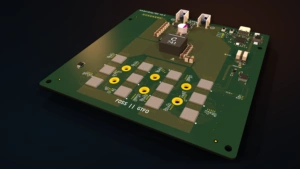
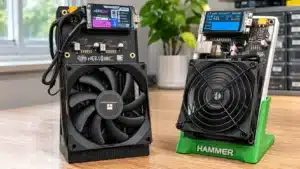
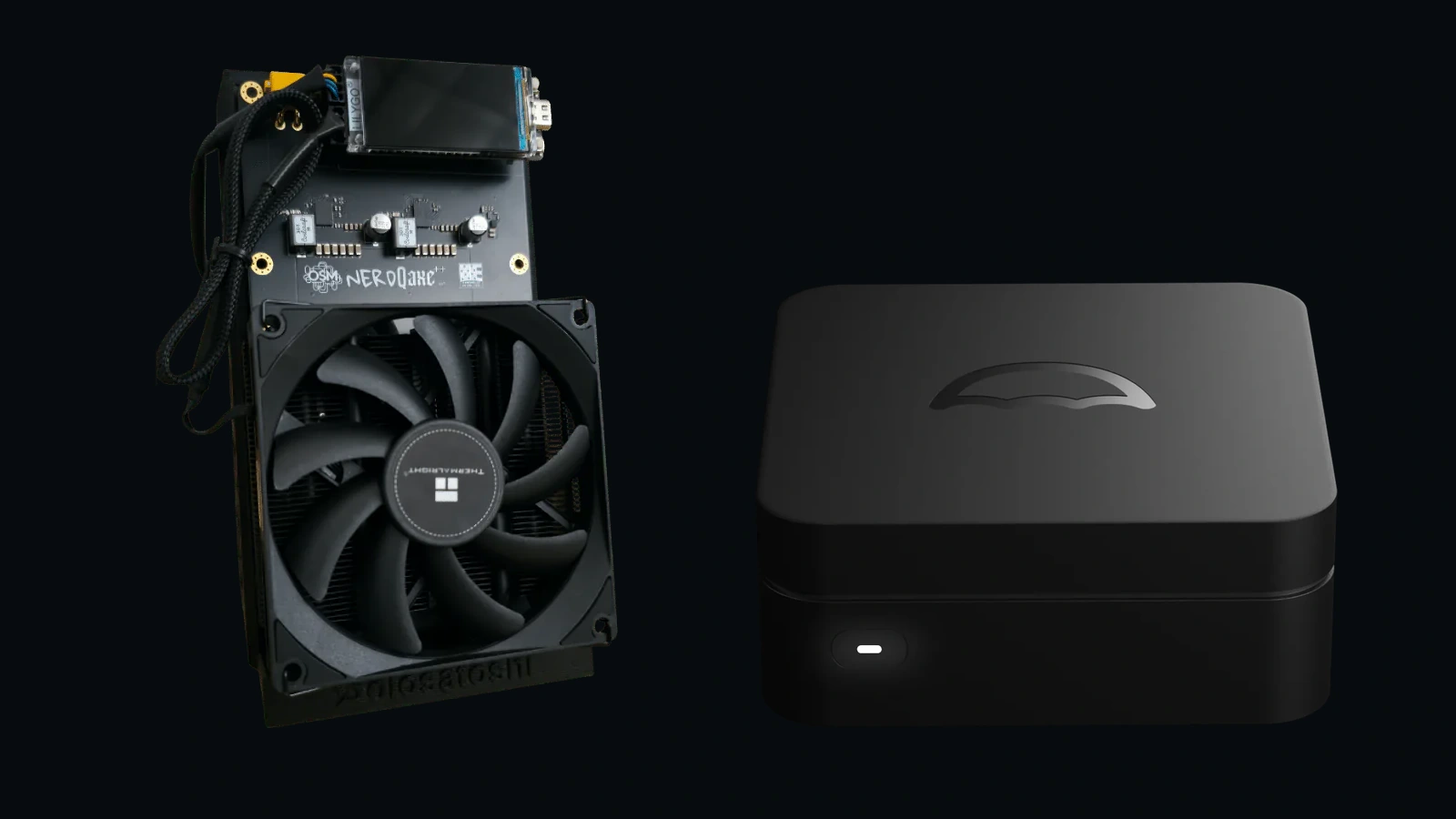
Pictured: a current NerdQaxe++ Revision 7 and an Umbrel Home. The customer’s historical setup used Revision 6 miners and Umbrel on an AK2 Plus mini PC. Product photos: Solo Satoshi and Umbrel.
Quick overview
- The reported win: A Solo Satoshi customer identified a NerdQaxe++ Revision 6 as the winning device within a six-NerdQaxe++ and Avalon Q setup.
- The on-chain reward: Block 920440 paid a 3.125 BTC subsidy plus 0.01615228 BTC in transaction fees, totaling 3.14115228 BTC.
- The self-hosted route: The operator ran Public Pool and Bitcoin Core on an Umbrel mini PC, rather than sharing the reward through a conventional pooled payout system.
- The evidence: The coinbase contains “Public Pool on Umbrel.” It does not identify the physical ASIC, its seller, or the operator’s tax outcome.
- The takeaway: Small miners can find valid blocks, but this exceptional result does not predict another miner’s waiting time or profitability.
What Is Public Pool?
Public Pool is open-source Bitcoin Stratum server software that connects compatible miners to a Bitcoin node for solo mining. A privately operated instance lets the owner run the mining service and configure its payout destination without relying on a hosted solo service.
In this case, the operator reported running the Public Pool app and Bitcoin Core on Umbrel. The service supplies mining jobs, receives submitted work, and sends a qualifying candidate block to the node. The node must validate the block, and the network must accept it; an ordinary accepted share is not a block reward. The Public Pool source repository documents the server and its configuration.
What Does the Block Record Confirm?
The record for block 920440 confirms an accepted Bitcoin block with 3.14115228 BTC in coinbase outputs and the coinbase text “Public Pool on Umbrel.” That text supports the software identification, while the operator’s report identifies the hardware and private setup.
- Height: 920440.
- Timestamp: October 23, 2025, at 19:32:45 UTC.
- Subsidy: 3.125 BTC.
- Transaction fees: 0.01615228 BTC.
- Total coinbase outputs: 3.14115228 BTC.
A contemporaneous Bitcointalk discussion also noted the Public Pool coinbase text. It is useful corroborating context, but a coinbase label is chosen by the block producer and is not an independent identity certificate for a device or operator.
The Customer’s Reddit Story
Reddit user u/EightofSpace reported the win in “I found a block. A BTC Block. Solo.” In follow-up replies, the operator identified Solo Satoshi Revision 6 hardware and confirmed Bitcoin Core and Public Pool on an Umbrel mini PC.
The operator described the moment in their own words:
Hey guys, it’s me again. I recently posted about a pc build i made with 6 nerdqaxe++. I recently got a Avalon Q as well and my total has is 120-130 TH.
I manage to do it. I fucking manage to do the god damn impossible. I got a mother fucking block. Everyone says it’s hard. Your wasting money. You’ll never find one. You have to get at least a few PT to have any chance. Well fuck those guys. I did it and we got proof now. A tiny NerdQaxe found a block against all odds, against the world.
And I solo mined. It was $342,564.17. Tax will eat up $158,000 leaving me with 200k-ish. I am so damn psyched and hyped.
The max difficulty i hit was 2.08 P. I had 212 G. You guys can do it. We all can do it. These small miners are so damn amazing. Also, I will delete all private DM. Don’t even bother scammers. And I also already “verified” and “sync” my wallet ok.
The dollar value and tax estimate above are the operator’s statements at the time. They are not a current Bitcoin valuation or a verified calculation of tax liability; the approximate net figure in the quotation does not reconcile exactly with the amounts quoted. The on-chain reward is the BTC total listed above.
What Was in the Reported Mining Setup?
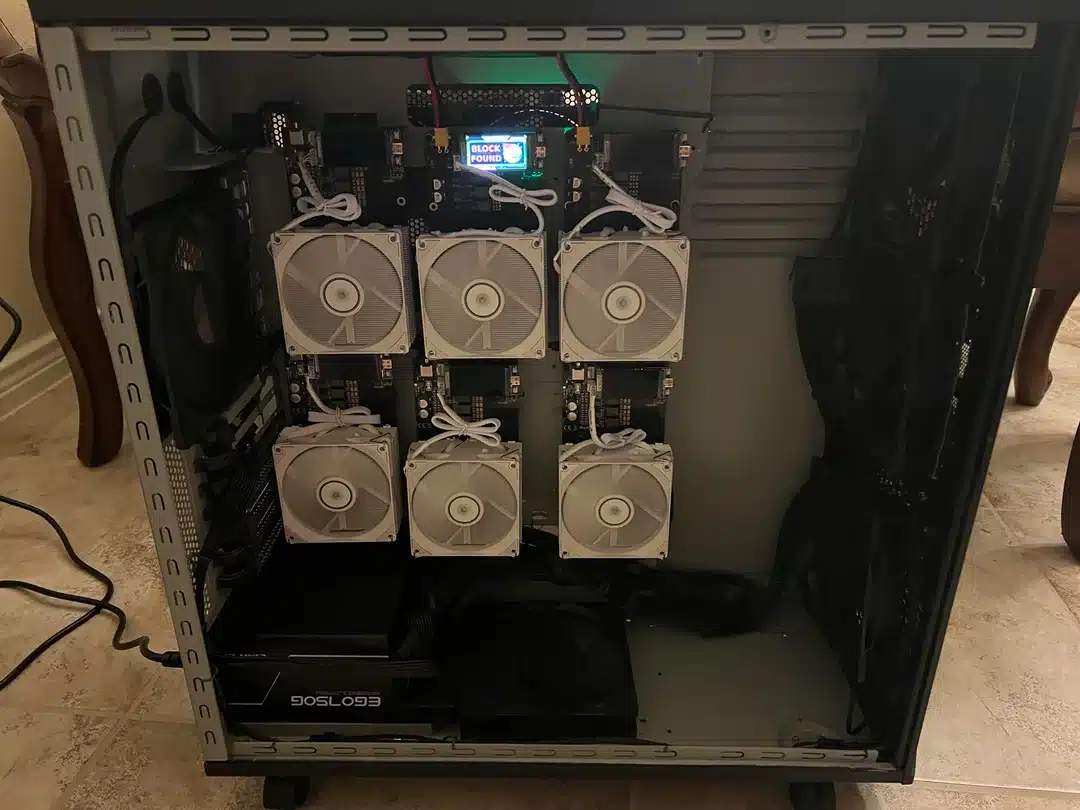
The operator reported six NerdQaxe++ Revision 6 miners plus one Avalon Q, totaling approximately 120–130 TH/s. That is the combined setup’s hashrate, not the output of a single NerdQaxe++.
The six smaller miners were mounted inside a repurposed PC tower. The operator’s earlier PC-miner build post describes the enclosure and airflow. It is a customer-built installation, rather than a standard product package or a tested wiring guide.
What does the reported 2.08 P best share mean?
The reported 2.08 P is a share-difficulty value, not petahashes per second. It exceeds the block’s network difficulty of approximately 146.716 T, but the number alone does not independently prove which physical device supplied the winning work.
Mining repeatedly tries candidate headers. A block needs an eligible hash and must satisfy all other consensus rules; the network’s accepted block is the decisive record. A best-share display is useful device or service telemetry, with its accuracy and attribution dependent on the underlying records. The Bitcoin developer mining guide explains the relationship between proof of work, targets, and block validation.
How Was This Different from the Earlier OCEAN Block?
The earlier NerdQaxe++ report associated with block 913272 on September 5, 2025 involved OCEAN’s shared-reward pool. Finding the winning hash through that arrangement does not give one worker the entire block reward.
OCEAN’s TIDES accounting distributes rewards according to eligible contributed shares. The October Public Pool report instead describes a private solo setup, where the operator configured the payout destination. These are different reward arrangements, even though both involve valid Bitcoin blocks.
Our NerdQaxe++ block case overview compares the reported events and their evidence.
Why Does This Matter for Home Mining?
This report shows how open-source desktop hardware, a home node, and self-hosted mining software can form a complete mining setup. It illustrates a possible outcome, rather than a typical return or a reason to expect a quick win.
- Accessible hardware: A small SHA-256 ASIC can produce a qualifying hash; size does not create a separate class of Bitcoin block.
- Operator control: Self-hosting lets the owner operate the node and mining service. It also brings responsibility for uptime, updates, payout configuration, and network access.
- Open-source participation: Hardware builders, firmware contributors, and projects such as Open Source Miners United help home miners understand and operate the stack.
Self-hosting does not make mining anonymous: block rewards are public on-chain, and network activity may reveal information. Nor does this block establish that Revision 6 universally runs cooler, more efficiently, or more safely than another revision.
How Does a Self-Hosted Public Pool Setup Work?
The basic path is miner → your Stratum mining service → your synchronized Bitcoin node. The hardware hashes candidate work; Public Pool coordinates jobs and submissions; the node validates and relays a valid candidate block.
- Choose compatible hardware and power. Verify the exact board revision, connector, supply rating, cooling, and firmware. A customer’s custom multi-device power arrangement is not a universal installation specification.
- Run and synchronize Bitcoin Core. The reported system used Umbrel on a mini PC. Keep the node synchronized and its storage and network connection healthy.
- Configure Public Pool. Set the intended receiving address and the service’s node connection, then point each miner to the actual Stratum host and port for that installation. Our Umbrel solo-mining setup guide covers that platform-specific route.
- Verify submitted work. Check miner connectivity, accepted submissions, the service’s worker records, node synchronization, and the configured receiving address. Accepted ordinary shares indicate work reaching the service, not guaranteed future rewards.
- Maintain reliable operation. Use appropriate electrical protection, stable power, suitable cooling, and current software. Protection behavior depends on the hardware and firmware; a fuse-free design is not a safety assurance.
- Understand the probability. Higher effective hashrate improves the rate of attempts, but there is no guaranteed deadline. Use the solo-mining odds calculator with current difficulty and your actual hashrate.
Keeping the service private requires appropriate local access controls. Do not expose node RPC credentials or administration interfaces as part of a routine miner connection.
Revision 6 and Current NerdQaxe++ Hardware
This October 2025 report concerns Revision 6; the current NerdQaxe++ product listing is Revision 7. Check the listing’s revision, configuration, and power-supply selection rather than assuming today’s package matches the historical build.
The Revision 6 introduction provides historical hardware context. Its specifications and the customer’s telemetry should not be treated as measurements of every later model.
Solo Satoshi supplied the reported Revision 6 units and supports home miners from Conroe, Texas. A block win is an exciting customer story, but hardware selection should still account for electricity costs, cooling, maintenance, and the possibility of no solo payout.
NerdQaxe++ Revision 6 video
This Solo Satoshi video introduces the historical hardware revision. It is product context, rather than footage proving block 920440.