Hashrate heating · Updated October 22, 2026
What if the heater keeping your home office comfortable could also earn Bitcoin? With hashrate heating, the electricity that warms your space also powers a Bitcoin miner. You get useful heat, contribute to the network, and collect mining rewards along the way.
That is the appeal of a Bitcoin mining heater: one device, two useful jobs. From a compact desktop miner to a thermostat-controlled heater, there is a practical way to bring mining into your daily routine.
What is hashrate heating?
Hashrate heating uses the heat produced by Bitcoin mining to warm a room or heat water. A miner performs SHA-256 calculations for the Bitcoin network, and nearly all the electricity it consumes ultimately becomes heat. Instead of moving that heat away, a mining heater puts it to work in your home.
A conventional electric resistance heater turns electricity into warmth. A Bitcoin mining heater does that too, while its ASIC chips also generate hashrate, the computing work used in mining. Connect it to a mining pool, and that work can earn Bitcoin rewards.
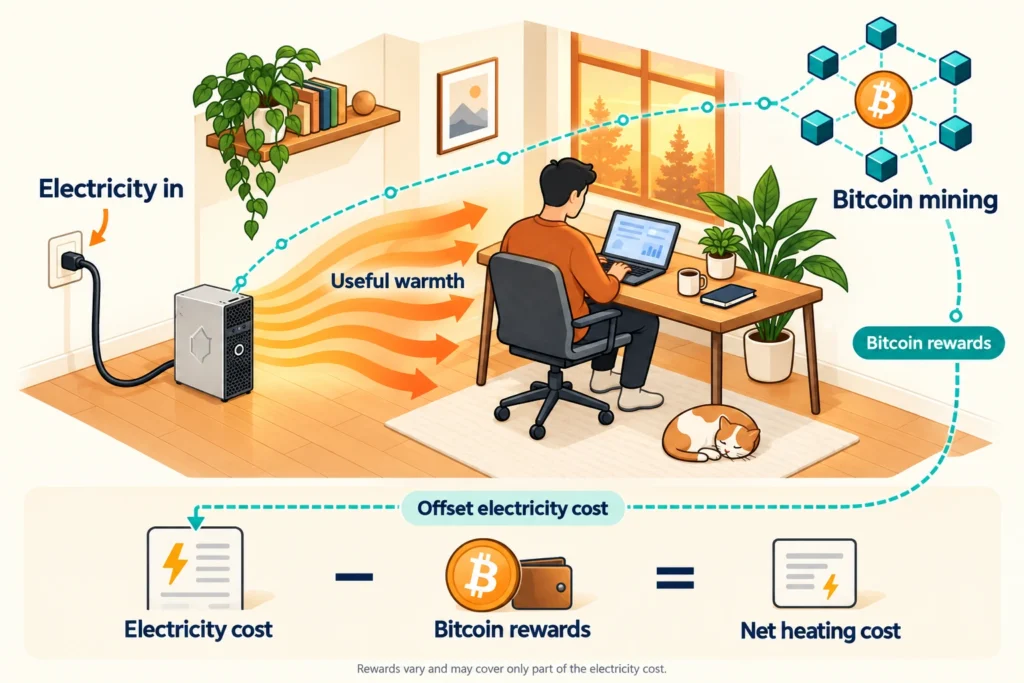
The rewards do not take heat away from the room. An 800W miner and an 800W electric resistance heater produce approximately the same amount of heat when operating at that power. The miner adds Bitcoin mining work to the process.
Why bring Bitcoin mining into your heating routine?
-
Comfort with a purpose
Enjoy warmth at your desk, in a home office, or around a workshop while your miner contributes hashrate.
-
Bitcoin from daily use
Pool rewards can offset part of the electricity bill, giving your heating budget another job.
-
A hands-on introduction
Learn about wallets, mining pools, and the Bitcoin network by running a miner you use every day.
This practical approach is part of the Heat Punks movement: finding useful applications for mining heat, from a comfortable workspace to hot water.
How much heat does a Bitcoin miner produce?
Watts tell you how much heat a miner can supply. Terahashes tell you how much mining work it performs. For a miner operating indoors with its exhaust kept in the space, each watt of electrical input produces approximately 3.412 BTU of heat per hour.
Heat output (BTU/h) ≈ power (W) × 3.412
A 140W desktop miner supplies about 478 BTU/h of localized warmth. An 800W mining heater supplies about 2,730 BTU/h. At 1,500W, the output rises to approximately 5,118 BTU/h, the same heat output as a 1,500W electric resistance heater.
Why watts and BTU/h do not determine room coverage
Heat output describes the heater’s capacity, not the room’s heating demand. A room holds a steady temperature when its total heat gains balance its heat losses. A miner’s wattage tells you how much it contributes to that balance; it does not establish how many square feet it can keep comfortable.
- Insulation and windows: Walls, roofs, floors, and glazing affect how quickly heat escapes. A well-insulated room retains warmth differently from a drafty garage with the same floor area.
- Outdoor and target temperatures: A larger temperature difference between indoors and outdoors increases heat loss through the building fabric. The heating needed on a mild day can be very different from a freezing night.
- Ceiling height and room layout: Floor area alone leaves out room volume, exposed wall area, and how warm air collects or moves between spaces.
- Air leakage and ventilation: Gaps around doors and windows, open doorways, and ventilation can carry warm air away and bring colder air in.
These factors explain why a broad claim such as “heats X square feet” is not a dependable sizing method on its own. For a primary heating system, use a room-by-room heat-loss calculation for your local climate and target temperature. For supplemental warmth, assess how much of the existing heating load the miner can cover. Your Home’s building-heat guidance explains how insulation, air leakage, and temperature differences affect heat retention.
Seasonal use and thermostat-controlled Bitcoin mining
What happens when the room reaches its target temperature?
Thermostat behavior depends on the model and operating mode. A unit may reduce mining power, stop and restart its mining hardware, or control a separate heating element. Check which part the thermostat controls. When hashing stops, the miner contributes no hashrate during that downtime, even if a later pool payout includes work completed earlier.
DIY Bitcoin miner heating with Home Assistant
Home Assistant can combine a room-temperature sensor with compatible miner controls or a suitable smart plug to automate mining heat around a target temperature. Energy monitoring can also help track electricity use and actual runtime.
For setup details, see Home Assistant’s Generic Thermostat documentation. Community tools such as Bitaxe Monitor can add mining statistics. Control support varies by model; use power switching only where the equipment manufacturers permit it and the plug is rated for the load.
Use actual mining hours in the calculator
Time plugged in is not always time spent mining. If a miner hashes for 12 hours across a 24-hour day, enter 12 daily runtime hours for that operating scenario. If it runs at reduced power, enter the matching power consumption and hashrate rather than full-power specifications.
Jump to the heating cost calculator to enter your miner’s actual runtime, power consumption, and hashrate.
What changes in summer?
Mining still produces heat when the room no longer needs it. Use the manufacturer’s supported operating modes to reduce output or stop mining when that warmth is unwanted. Running air conditioning to remove mining heat adds electricity use that the calculator does not include. Water heating may remain useful outside the space-heating season, provided operation follows the system’s hot-water demand, storage limits, and temperature controls.
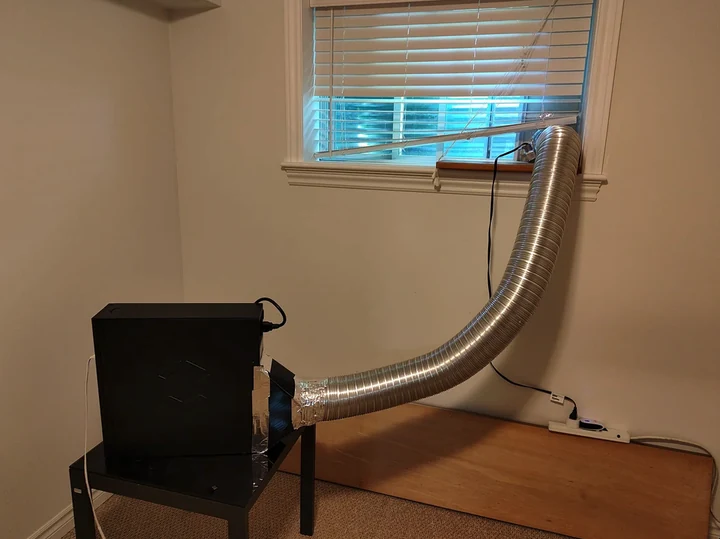
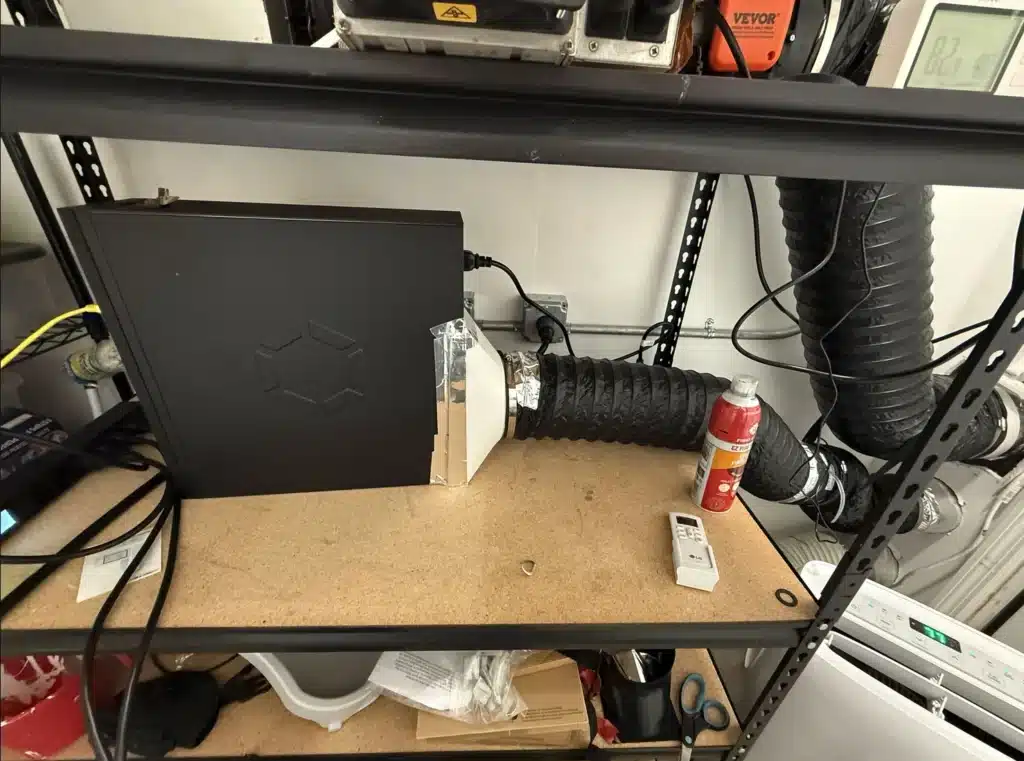
Real-world Bitcoin miner ducting examples
Some owners use an exhaust adapter and ducting to move mining heat where it is useful in winter, or vent it outdoors in summer. These community installations illustrate the idea; duct layout and airflow requirements depend on the miner. Exhausting room air outdoors also draws replacement air into the home, which can affect heating or cooling demand.
Bitcoin mining heaters vs. electric heaters and heat pumps
Compare the cost of delivering the same amount of useful heat. Bitcoin rewards can reduce a miner’s net operating cost, but they do not automatically make it the cheapest heating option.
Electric resistance heaters: A portable electric heater or electric baseboard converts approximately 1 kWh of electricity into 1 kWh of heat at the point of use. The electricity cost depends on power, runtime, and your rate.
Bitcoin mining heaters: Nearly all the electricity a miner consumes also becomes heat. If that heat stays in the space you want to warm, an 800W miner provides approximately the same heat as an 800W resistance heater. Its financial advantage comes from any Bitcoin rewards earned, rather than greater heat output per unit of electricity. Heat exhausted outdoors or produced when you do not need warmth does not provide the same heating benefit.
Heat pumps: A heat pump moves heat into your home instead of relying only on electricity converted directly to heat. It can deliver roughly two to four units of heat per unit of electricity, according to the University of Maryland Extension. This ratio is called the coefficient of performance, or COP. A COP of 3 means 1 kWh of electricity delivers 3 kWh of heat. Actual performance varies with the equipment, installation, and operating conditions.
A mining heater can make sense when you want mining hardware and can use its warmth, especially when replacing resistance heat. If you already have an efficient heat pump, compare the miner’s cost after rewards with the heat pump’s cost for the same useful heat. The calculator below estimates the miner’s electricity cost and rewards; it does not model a heat pump.
Beyond heating: Bitcoin ownership and self-custody
Heating your home while accumulating Bitcoin
A mining heater can also appeal to people who want to accumulate Bitcoin rather than sell their rewards immediately. Alongside useful warmth, it produces Bitcoin rewards that can be held for the future. Bitcoin has a history of substantial long-term appreciation, as well as negative years and major declines, documented in BlackRock’s historical analysis.
If Bitcoin’s price rises after you earn rewards, the Bitcoin you retained becomes worth more in dollar terms. That potential future appreciation can be part of the appeal of mining heat, but it is separate from the heat pump’s energy-efficiency advantage. Bitcoin’s price can also fall; holding it does not guarantee an increase in value.
If you keep the Bitcoin, you still pay the full electricity bill in cash. The calculator’s cost after rewards subtracts their estimated dollar value at the selected Bitcoin price; it does not project appreciation or automatically pay your utility bill. A complete financial comparison can also consider using a heat pump’s electricity savings to buy Bitcoin directly. That comparison should account for privacy: buying through a KYC exchange links the purchase to a verified identity, while mining through a service without KYC avoids that exchange identity check.
Acquiring Bitcoin without exchange KYC
Mining can also provide a way to acquire Bitcoin without buying it through an exchange that requires know-your-customer (KYC) identity checks. With a mining setup and payout service that do not require KYC, rewards can be received in a wallet you control. Requirements vary by pool or service, so check its policies. This can offer an additional acquisition and self-custody benefit, but it does not make the Bitcoin anonymous: on-chain transactions remain public and traceable.
How Bitcoin rewards can offset heating costs
Expected rewards change with Bitcoin’s price, network difficulty, and pool fees. Treat the estimate as a snapshot rather than a guaranteed return.
Explore your heating costs
See how Bitcoin rewards could offset the electricity behind your warmth.
Enable JavaScript to adjust the sliders. Live estimates require JavaScript. You can calculate electricity use as watts ÷ 1,000 × daily hours × 30, then multiply by your electricity rate.
Air heating with Bitcoin miners
Air-cooled Bitcoin miners recover heat directly into the room. Their specialized mining chips, called ASICs, transfer heat to heatsinks, while fans move air across those surfaces and circulate warm air into the space. This fan-driven heat transfer is called forced convection.
This approach suits localized desk warmth or supplemental room heating where airflow and fan noise are acceptable. Heating capacity depends on the miner’s actual electrical power consumption and how much heat stays in the room, rather than its hashrate alone. Thermostat control, fan speed, and operating modes affect comfort and runtime.
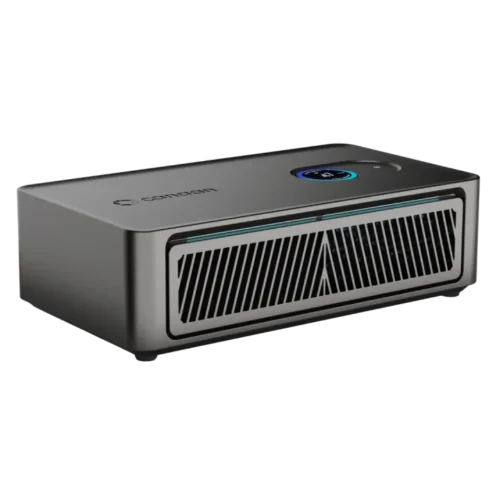
Localized warmth at a desk
Avalon Nano 3S
$219 · 6 TH/s · Up to 140W · Approximately 478 BTU/h
The Nano 3S provides a small stream of warm air beside or beneath a desk. Its compact size suits a home office where you want warmth close to your hands or feet while the miner earns Bitcoin. Leave clear space around the inlet and outlet so air can circulate freely.
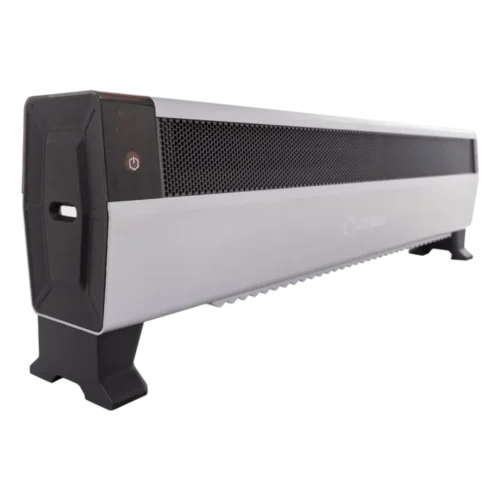
Thermostat-controlled room heat
Avalon Mini 3
$749.99 · 37.5 TH/s · Up to 800W · Approximately 2,730 BTU/h
The Mini 3 is designed around everyday room heating. Its slim, baseboard-style enclosure fits along a wall, while temperature control regulates the warmth. It is a practical choice for bringing Bitcoin mining into the heating routine of a home office or living space.
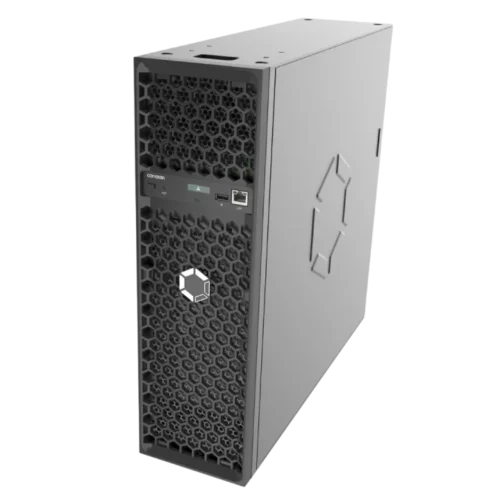
Higher heat output for a dedicated space
Avalon Q
$1,349 · 90 TH/s · 1,674W rated power · Approximately 5,712 BTU/h
The Avalon Q supplies a stronger flow of warm air for a larger workspace or dedicated mining area. Its higher electrical load produces more heat, so placement, clear airflow, and a suitable circuit for a continuous electrical load are central to using that warmth effectively.
For a detailed model comparison, operating modes, app setup, and monitoring, read our Canaan Avalon Home Series guide.
Disclosure: Heatbit Explore buttons use affiliate links. Solo Satoshi may earn a commission on purchases made through them.

Air heating + filtration
Heatbit Trio
$849 · 10 TH/s · Up to 1,500W · Approximately 5,118 BTU/h
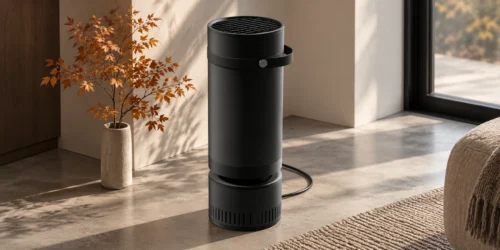
The Trio combines three functions in a cylindrical appliance: mining, heating, and HEPA air filtration. Its mining section uses 400W and produces about 1,365 BTU/h of heat. An additional 1,100W electric heating element brings the total to 1,500W for a stronger warm-up.
This hybrid design separates mining output from total heating output. Switching on the extra heating element adds warmth; the mining section remains approximately 10 TH/s. App controls and a touchscreen make it approachable as an everyday home appliance.
Air heating + filtration
Heatbit Maxi
$1,249 · Approximately 39 TH/s · 1,500W · Approximately 5,118 BTU/h
The Maxi moves to a mining-first design, using its computing hardware as the heat source rather than adding a separate heating coil. It combines approximately 39 TH/s with 1,500W of room heat, HEPA air filtration, and top-mounted controls.
It is a substantial increase in mining output over the Trio at the same maximum heating power. That makes it a useful comparison for anyone choosing between a hybrid appliance and a heater built around mining.

Air heating + filtration
Heatbit Maxi Pro
$1,499 · Up to 60 TH/s · 1,500W · Approximately 5,118 BTU/h
The Maxi Pro raises mining output to 60 TH/s while keeping the same 1,500W power level and air-filtration function as the Maxi. Its calculated efficiency is about 25 J/TH, compared with approximately 38.5 J/TH for the 39 TH/s Maxi. Lower J/TH means more mining work for each watt.
Both models provide approximately the same amount of room heat. The Pro’s advantage is the additional hashrate from that electricity, alongside the heater-purifier format and app-based monitoring.
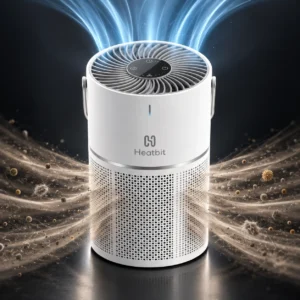
A purifier is a different starting point. The Heatbit Bitair combines air purification with 1.2 TH/s of mining at up to 25W total appliance power. Its approximately 85 BTU/h of heat makes it an entry into mining and air filtration, rather than a room-heating option.
Bitcoin mining water heaters
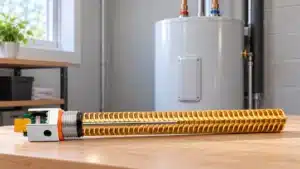
Bitcoin mining water heaters use heat from ASIC mining hardware to warm water for showers, sinks, and other household needs. A purpose-built unit combines mining with hot-water production. A retrofit mining element can instead use a compatible existing electric tank. In a separate heat-recovery installation, a heat exchanger can transfer energy from a miner’s cooling circuit to a hot-water system while keeping the fluids separate.
This approach is most useful where there is regular hot-water demand. Useful output depends on recovered heat, storage capacity, incoming water temperature, and the temperature you need at the tap. Electrical input alone does not establish hot-water delivery performance. The mining equipment, plumbing, and controls need to work together as a designed system.
Retrofit household water heating
Heatbit Bitwater
$899 Genesis batch · Up to 34 TH/s · Up to 600W
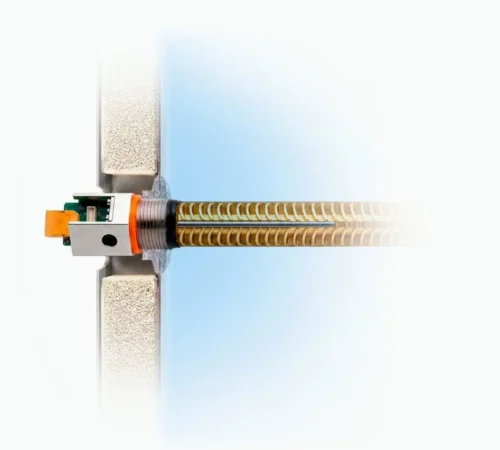
Bitwater replaces the lower screw-in element in a compatible existing electric water tank. Heatbit specifies standard 30–80 gallon US and Canadian tanks with a 1-inch NPSM fitting; gas and heat-pump water heaters are not supported.
Mining chips transfer heat into the water. Autotune varies power and hashrate, while the tank’s upper element remains available. The Heatbit app provides monitoring and control.
Heatbit plans shipping for Q1 2027. Published specifications describe an upcoming product, rather than independent test results.
The calculator preset covers the mining element only. Use actual power, hashrate, and runtime; account separately for electricity used by the tank’s upper heater.
Household hot water
Superheat H1C
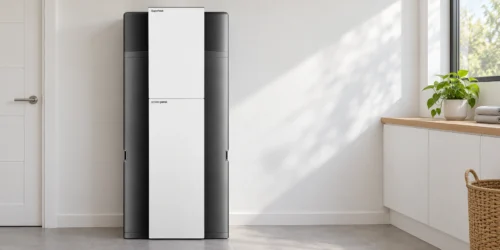
$2,999 · 140 TH/s · 3.3kW
The Superheat H1C combines a Bitcoin miner with a water-heating system for showers, sinks, and everyday hot-water use.
Instead of releasing the miner’s heat into the room, the system transfers it to stored water. The H1C has a 3.3kW power specification, and its current design lists a 140 TH/s mining module. That brings the same dual-purpose principle to a larger household appliance: electricity provides hot water while the mining hardware performs Bitcoin work.
The Superheat app and web console provide monitoring for the device and mining activity. Water heating also involves plumbing and electrical installation, so it is a larger home project than setting up a desktop miner or a freestanding heater.
Read more about the concept in our coverage of Superheat’s Bitcoin mining water heater.
Radiant heating with Bitcoin miners
Bitcoin miners can supply radiant heating through a warm panel or a heated building surface. A panel such as the Heatbit Canvas transfers heat by infrared radiation to people and surrounding surfaces, while natural convection also warms the air. This provides localized comfort without relying on a fan blowing warm air across the room.
Hydronic heating carries heat in circulating water or another suitable fluid. In a typical mining heat-recovery system, liquid-cooled miners transfer heat through an exchanger to a separate building loop. Tubing warms a floor slab by conduction; the floor then releases heat through radiation and convection. Similar loops beneath driveways or walkways can melt snow and ice. These installations require heat-output, fluid-temperature, and surface-area calculations; they are a different project from installing a self-contained radiant panel.

Decorative radiant warmth
Heatbit Canvas
$399 · 10 TH/s · 300W · Approximately 1,024 BTU/h
The Canvas brings Bitcoin mining into a fanless radiant panel. Rather than relying on a stream of warm air, it provides radiant warmth beside a desk, seating area, or other personal space. Its paintable surface also makes it an interior feature: you can customize the panel with artwork instead of hiding the miner away.
At 300W, it provides a useful step up from desktop-scale heat while keeping the power requirement modest. The fanless design is its standout feature for a quiet workspace.
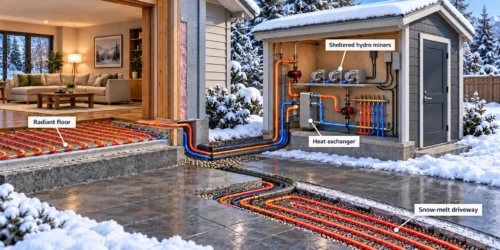
Heated floors and snow melting
Hydro-cooled miners
Hydronic heating · Heat exchanger · Circulating fluid loop
Hydronic heating moves heat through a circulating fluid loop. With hydro-cooled Bitcoin miners, the fluid absorbs heat from the mining hardware. A heat exchanger transfers that energy into a separate heating circuit, keeping the miner coolant apart from the fluid serving the floor or driveway.
Radiant floor heating
A circulation pump moves warm fluid through tubing beneath the floor. Heat spreads through the slab and floor surface, providing warmth across the room while the connected miners produce hashrate. Zoned controls let different areas follow their own temperature settings.
Driveway and walkway snow melting
The same heat-recovery approach can supply tubing beneath a driveway, walkway, or entrance. A suitably specified water-and-glycol mixture circulates through the outdoor loop to warm the surface and help melt snow and ice. Temperature and moisture sensors can control when heating runs.
The heated area, local weather, slab construction, and available fluid temperature determine how much mining heat the system needs. Matching the number of miners and the tubing design to that heating load is central to an effective installation.
Compare Bitcoin mining heaters by budget
From desktop warmth to higher-output heating, these models offer different combinations of price, mining performance, and comfort. The lineup below runs from the lowest to the highest starting budget.
| Model | Price | Hashrate | Power | Heat output | Heating style |
|---|---|---|---|---|---|
| Avalon Nano 3S | $219.00 | 6 TH/s | 140W | ≈ 478 BTU/h | Desktop airflow |
| Heatbit Canvas | $399.00 | 10 TH/s | 300W | ≈ 1,024 BTU/h | Radiant panel |
| Avalon Mini 3 | $749.99 | 37.5 TH/s | 800W | ≈ 2,730 BTU/h | Thermostat-controlled airflow |
| Heatbit Trio | $849.00 | 10 TH/s | 1,500W | ≈ 5,118 BTU/h | Air heating + filtration |
| Heatbit Bitwater | $899.00* | Up to 34 TH/s | Up to 600W | ≈ 2,047 BTU/h | Retrofit water-heating element |
| Heatbit Maxi | $1,249.00 | ≈ 39 TH/s | 1,500W | ≈ 5,118 BTU/h | Air heating + filtration |
| Avalon Q | $1,349.00 | 90 TH/s | 1,674W | ≈ 5,712 BTU/h | Higher-output airflow |
| Heatbit Maxi Pro | $1,499.00 | Up to 60 TH/s | 1,500W | ≈ 5,118 BTU/h | Air heating + filtration |
| Superheat H1C | $2,999.00 | 140 TH/s | 3,300W | ≈ 11,260 BTU/h | Household water heating |
Bring hashrate heating home
Start with the heating job you want to accomplish, then choose a Bitcoin mining setup that can supply useful heat in that form.
- Air heating: Use warm airflow for a desk, workspace, or supplemental room heating. Match the unit’s output, controls, and fan noise to the room’s heat loss and how you use the space.
- Domestic hot water: Consider a purpose-built mining water heater or a compatible retrofit element where there is regular household hot-water demand. Compare storage and recovery performance, and plan the plumbing and electrical installation.
- Radiant and hydronic heating: Choose a self-contained radiant panel for localized comfort, or plan a designed heat-recovery system for heated floors and outdoor snow melting. Hydronic projects require a compatible heat source, heat exchanger, circulation loop, and controls sized for the heating load.
Compare equipment and installation costs alongside operating electricity and expected rewards. Use actual mining hours, power consumption, and hashrate in the calculator, then track measured energy use and pool payouts once the system is running. Follow the manufacturer’s installation requirements, with appropriate electrical, plumbing, or heating-system expertise for the project.
The common principle is useful heat recovery: choose a setup that puts mining heat where you need it, while the hardware performs Bitcoin mining work.
Put your heating budget to work
Browse our mining heaters for room warmth, or explore the water and radiant heating options above when planning a larger heat-recovery project.
Bitcoin mining heater FAQs
What is a Bitcoin mining heater?
Does a Bitcoin miner produce more heat than an electric heater?
How much of my electricity bill can Bitcoin rewards offset?
Is Bitcoin mining heat cheaper than a heat pump?
How much electricity does a Bitcoin mining heater use?
How large a room can a Bitcoin miner heat?
Are Bitcoin mining heaters quiet enough for a living room?
Can a thermostat control a Bitcoin mining heater?
What should I do with mining heat during summer?
Can Bitcoin miners supply underfloor heating or hot water?