AI is coming for your bitcoin in two ways. First, attackers now run frontier AI models over open-source wallet firmware to find bugs humans missed for years. Second, AI makes phishing and voice cloning cheap enough to aim at every name in a leaked customer list, and those lists keep leaking from shipping partners, email providers, and payment processors.
This guide covers what changed and the habits that still hold. It builds on our practical guide to protecting your bitcoin. Read that first if you are new to self-custody.
Key takeaways
- Frontier AI now finds and exploits software bugs on its own. Google confirmed the first criminal zero-day written with AI in May 2026.
- Coinkite believes AI found the five-year-old Coldcard seed bug. At least 15 attackers then swept about 1,596 BTC from 7,300 addresses without touching a device.
- Follow-up AI audits found 85 more critical entropy findings in other wallet code. A seed you randomized yourself with dice is the defense that does not depend on any vendor.
- Your data is the fuel. One shipping vendor leaked about 81,000 Trezor customer addresses, and on September 9 attackers sent phishing from Trezor’s own email domain.
- Deepfake scam losses in 2026 already beat all of 2025 by 263%. “It looked legitimate” is no longer a defense. Process is.
- AI is also used for profiling, seed-hunting malware, fake wallet apps, poisoned search and AI answers, deepfaked KYC, SIM swaps, and passphrase guessing.
What does “AI is coming for your bitcoin” mean?
It means attackers now have two abilities that used to belong only to well-funded teams: automated bug hunting in the code that guards your keys, and personalized deception at scale.
Bitcoin’s cryptography is not the target. Nobody is brute-forcing a properly generated 256-bit key, and no AI changes that math.
What AI changes is everything around the math. The firmware that generates your seed. The app that shows your addresses. The email account that resets your exchange password. The voice on the phone claiming to be support. Those were always the weak points. AI makes them cheaper, faster, and possible to attack in bulk.
The two threats compound. AI reads code better than most humans and never gets bored, so old bugs in open-source firmware are being found now. AI writes a flawless email in your language, clones a voice from a podcast clip, and joins three leaked databases to learn which wallet you own, when it shipped, and where.
How do attackers use AI to find wallet firmware bugs?
They point a frontier model at a public code repository, ask it to find exploitable bugs, and let it run. In 2026 that produces working exploits against code that survived years of human review.
The turning point was April 7, 2026, when Anthropic announced Project Glasswing and revealed Claude Mythos Preview, a model it declined to release publicly because of what it could do. In about a month of testing, the model found thousands of zero-day vulnerabilities across every major operating system and browser. One was a 27-year-old bug in OpenBSD. Another was a 17-year-old remote root exploit in FreeBSD that it found and exploited with no human help after the first prompt.
That model is gated. The capability is not. Anthropic itself expects other companies to have Mythos-class models within 6 to 12 months, some without safeguards, and the models already on the market are good enough. Security firm Forescout found in April that commercial models could find and exploit vulnerabilities from single prompts, including one in code its own researchers had reviewed by hand and missed.
Criminals noticed. On May 11, 2026, Google’s Threat Intelligence Group published the first confirmed case of a criminal group using an AI-built zero-day exploit, a two-factor bypass intended for a mass campaign. CrowdStrike’s 2026 threat report counted an 89% rise in AI-enabled attacker activity in a year.
Why open-source bitcoin hardware is in the blast radius
Every serious bitcoin device is open source on purpose. Your wallet’s seed code, your bitcoin miner’s, and your node’s software are all public so anyone can verify them.
That is the right design. It’s also exactly what an AI bug hunter wants: full source, full commit history, and a clear payout for whoever finds the flaw first. Open source does not create bugs. It means they get found, and in 2026 the finder may be a model rented by the hour.
What did the Coldcard exploit prove?
It proved that one hidden build error in an air-gapped wallet can be found by machine, exploited offline, and turned into the largest hardware wallet theft in bitcoin’s history. No device was physically touched.
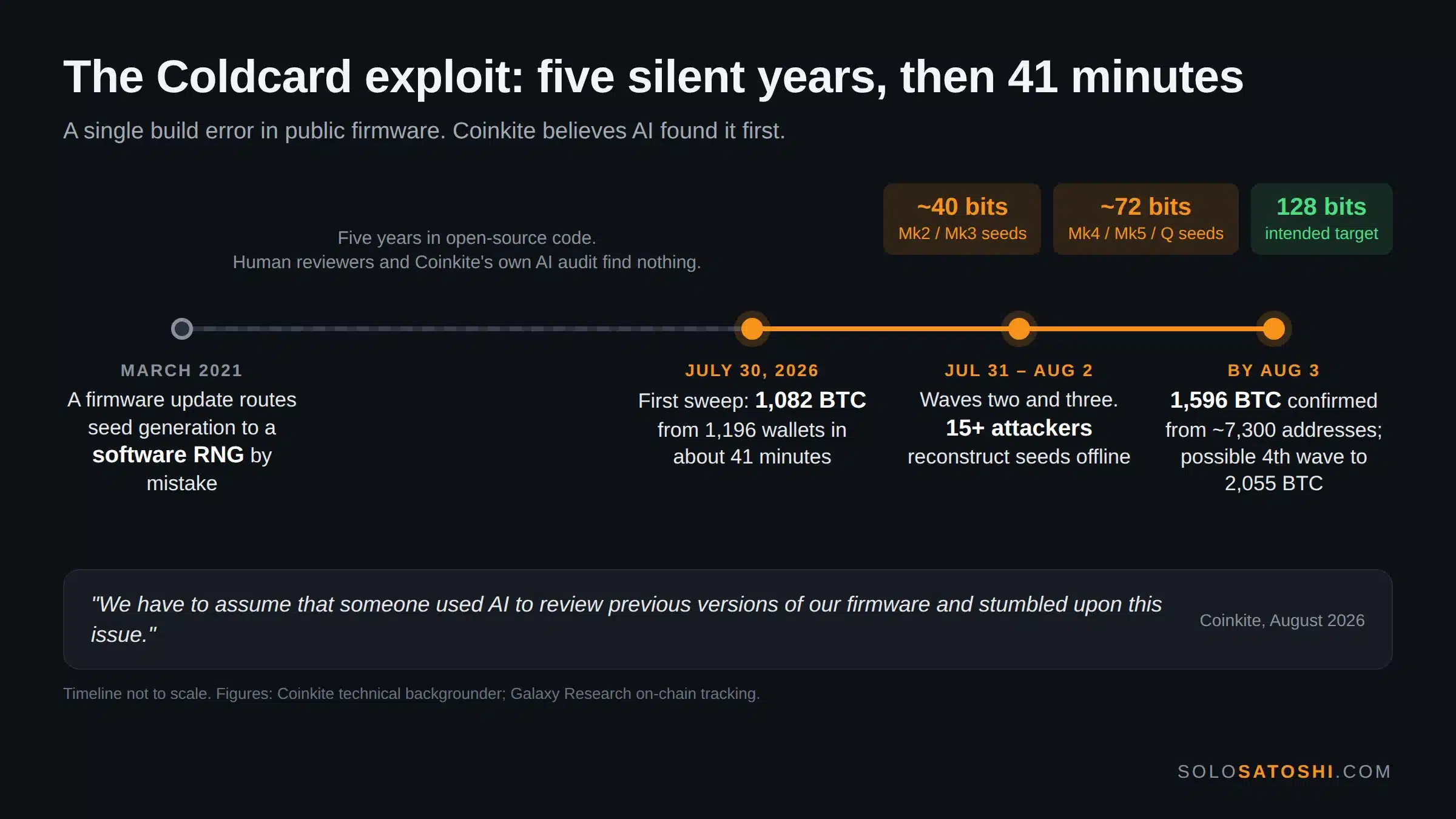
The bug was mundane. A March 2021 firmware update pulled in a new crypto library, and one wrong conditional check quietly routed seed generation to a software random number generator instead of the chip’s hardware one. The hardware generator kept running everywhere else, so reviewers saw it present and called. Only the one path that mattered was wrong.
Coinkite’s technical backgrounder puts the effective search space at about 40 bits on Mk2 and Mk3 and about 72 bits on Mk4, Mk5, and Q, against a 128-bit target. The math and migration steps are in our seed phrase entropy guide. Here, the AI angle is what matters.
The flaw sat in public code for five years. Then, from July 30, 2026, it was exploited in waves. Galaxy Research confirmed 1,596 BTC stolen from about 7,300 addresses, with a suspected fourth wave pushing the total toward 2,055 BTC. The first sweep moved 1,082 BTC from 1,196 wallets in about 41 minutes. At least 15 separate attackers took part.
How was it found after five quiet years? Coinkite’s own answer: the company has to assume someone used AI to review earlier firmware, and its own recent AI audit of the same code found nothing. Both sides had the same tools. That time, they helped the attacker first.
The part that should worry every wallet owner
Coldcard was the visible case, not the only one. In the weeks after, researchers ran AI-assisted analysis across other wallet firmware and shared crypto libraries and reported 85 critical findings of the same family: silent fallbacks, weak reseeding, build settings that produce less randomness than the source suggests. Most are still under coordinated disclosure.
The honest conclusion: you cannot verify a vendor’s build pipeline, and apparently neither can the vendor. What you can do is refuse to depend on it. A seed built from your own dice rolls or Entropia draws is secure even if the device’s random number generator is completely broken, because mixing entropy sources can only make the result stronger. Every Coldcard owner who had added 50 or more of their own dice rolls was excluded from the risk. That is the whole argument in one sentence.
How has AI changed phishing and impersonation?
AI removed every tell that used to give a scam away: the broken English, the generic greeting, the wrong product name, the recorded voice. Scams are now personal, fluent, and mass-produced.
The numbers reflect it. TRM Labs reported in August that deepfake scam losses in 2026 already exceed all of 2025 by 263%, and that scams are the only crypto-crime category where AI use has reached a “mature” level. Chainalysis found inflows to impersonation scams up more than 1,400% year over year, and scam operations using AI services earning about 4.5 times more than those without.
The tactics are familiar; the execution is not. Google has documented a North Korean group using a commercial AI model for crypto reconnaissance, phishing copy, and deepfake video of known industry figures. The two largest thefts of the year, at Kelp DAO and Drift Protocol, came from human signers worn down by long social-engineering campaigns, not from broken code. The largest individual loss of 2026, the $282 million January theft, began with one holder believing they were talking to wallet support.
AI has also created a new failure mode: attacking the AI you trust. In May, security firm Blockaid flagged a $175,000 loss from an AI trading agent that decoded a Morse-code message into a hidden transfer instruction. If an AI agent holds keys or approves transactions, everything it reads becomes an attack surface.
Our advice is simple. No AI agent should ever hold a key to bitcoin you care about. A signing device that shows the address and amount on its own screen is the only reliable check on anything, human or machine, that builds a transaction for you.
What other ways do attackers use AI to get bitcoin?
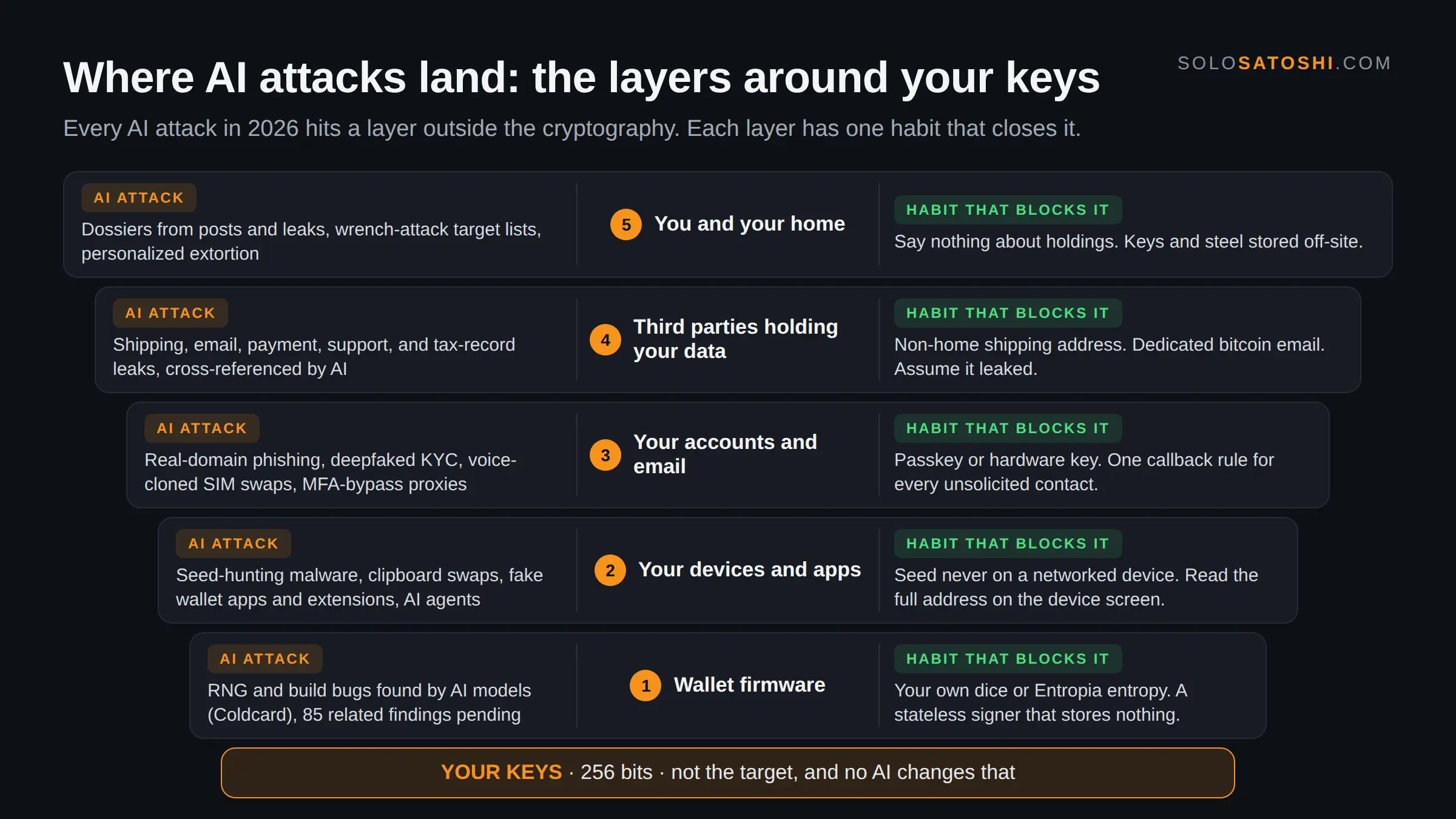
Beyond firmware bugs and phishing, AI is being used at every step between “this person owns bitcoin” and “the coins moved.” The full list below is grouped by where each attack lands. Each entry gives the method and the one habit that blocks it.
Finding and profiling you
- Automated dossiers. AI scrapes your social posts, forum history, podcast appearances, and leaked databases into one profile: name, address, wallet brand, rough holdings. Defense: never discuss holdings under any handle that links to you, and treat old posts as still live.
- Linking addresses to identities. Machine-learning clustering ties your addresses together and matches them to exchange withdrawals, dust you received, or a donation address you once posted. Defense: fresh address for every payment, no address reuse, coins you want private never touch a KYC exchange directly.
- Target selection for physical attacks. Leaked shipping data, a photo with a street sign, and a public post about “stacking” is enough for AI to rank you as worth a home visit. Defense: the wrench-attack section of our protection guide, starting with keys stored away from home.
Getting into your devices
- Seed-hunting malware. Infostealers now run image recognition over your photos and screenshots looking for 12 or 24 words on a grid, then scan notes apps, cloud drives, and password managers. Defense: a seed that has never been photographed or typed into a networked device.
- Clipboard and address swaps. Malware watches for a bitcoin address on the clipboard and replaces it with the attacker’s, or edits the address your wallet app displays. AI makes the malware harder to detect and easier to write. Defense: read the full address on the hardware wallet screen, every time.
- Fake wallet apps and browser extensions. AI-generated clones of real wallets, with AI-written five-star reviews, in app stores and extension marketplaces, plus “AI assistant” extensions that ask for permission to read every page you visit, including your wallet. Defense: install from the vendor’s typed URL only, and run no extensions on the browser you use for bitcoin.
- Poisoned software dependencies. Attackers register the package names AI coding tools tend to hallucinate, or compromise a real maintainer account, so a routine update pulls in a wallet drainer. Ledger’s 2023 Connect Kit incident was this pattern before AI made it cheaper. Defense: for most holders, none needed beyond a hardware wallet; the device screen is the last line when the software above it is compromised.
Tricking the tools you trust
- Poisoned search and AI answers. Attackers publish AI-written “support” sites, tutorials, and forum posts so that Google, ChatGPT, or an AI Overview recommends a fake download or a fake support number. AI chatbots also invent plausible URLs, and attackers register them. Defense: get download links and support contacts from the manufacturer’s site, typed by hand, never from a search result, an ad, or an AI answer.
- Deepfaked identity checks. Toolkits sold this year use generated video and cloned voice to pass exchange KYC and account-recovery checks, taking over your exchange account without your password. Defense: keep savings off exchanges; on any account you do keep, use a hardware security key and turn on withdrawal address whitelists with a time delay.
- SIM swaps by voice. A cloned voice and a leaked date of birth talk a carrier rep into moving your number, then every SMS code lands with the attacker. Defense: passkeys or hardware keys instead of SMS, and a carrier port-out PIN.
- Prompt injection against AI agents. If an AI agent manages a wallet, any text it reads is a command channel: a Morse-code message drained one trading agent of $175,000 in May. Defense: covered above, and worth repeating: no agent holds keys.
Long cons run by machine
- Romance and “investment” scams at scale. Chatbots now hold hundreds of months-long conversations at once, in fluent local language, steering victims toward fake platforms. This is the largest scam category by dollars and the one AI has industrialized most. Defense: no one you met online gets to recommend where your bitcoin lives.
- Fake recruiters and fake contributors. State-backed groups use AI personas to land jobs at wallet companies or to submit poisoned pull requests to open-source wallet code. Defense: out of your hands as a holder, which is another argument for user-supplied entropy and a stateless signer that limits what any single code change can leak.
- Personalized extortion. The “I have your password” email now arrives with your real address, your wallet brand, and a deepfaked clip. Defense: assume the data is real and the threat is automated; do not reply, do not pay, do report.
Attacks on the hardware itself
- Guessing weak passphrases and brain wallets. AI builds smarter wordlists from your public writing and from how people actually choose passphrases, then brute-forces any BIP39 passphrase or brain wallet built from quotes, names, or dates. Defense: a passphrase that is long and random, backed up in steel, not memorable.
- Side channels. Researchers have used machine learning to recover PINs and keys from a device’s power draw or electromagnetic emissions, and to reconstruct typed text from the sound of keystrokes. These need physical proximity or a stolen device. Defense: a stateless signer holds nothing to extract, and a stored-seed device should never be left where a stranger can plug into it.
- Firmware and RNG bugs. The Coldcard case above. Defense: your own dice.
The pattern across all of these: AI attacks the layers around your keys, and every defense is a habit, not a product. The hardware wallet screen, your own entropy, and a fixed verification rule for every unsolicited contact cover most of this list.
Where are attackers getting your data?
In most cases, from the companies around the wallet maker, not the wallet maker itself. In 2026 the leaks came from a fulfillment warehouse, a payment processor, an email provider, and a national tax agency.
This is the fuel for everything in the previous section. A phishing email only works if it reaches someone who owns the product it names. A wrench attack needs an address. AI does the cross-referencing. Trezor has said attackers are combining data from multiple leaked databases across different crypto services to sharpen their targeting.
| Leak | What got out | What followed |
|---|---|---|
| Global-e Ledger’s payment processor Jan 2026 |
Names, addresses, emails, phones, orders | Fake “Ledger–Trezor merger” phishing within days |
| ShipMonk Trezor’s shipping partner Aug–Sep 2026 |
~81,000 customers: name, home address, phone, email | Phishing calls and letters with QR codes at home addresses |
| Email provider Trezor’s sending platform Sep 9, 2026 |
Ability to send from trezor.io | Fake “STM32 entropy” firmware alert from the real domain |
| Tax agency France 2026 |
Verified list of crypto holders | Most of this year’s reported wrench attacks |
| Ledger e-commerce 2020 leak still active |
~272,000 home addresses | Fake letters, counterfeit devices, threats, six years on |
Compiled from Trezor, Ledger, and Chainalysis disclosures, September 9, 2026.
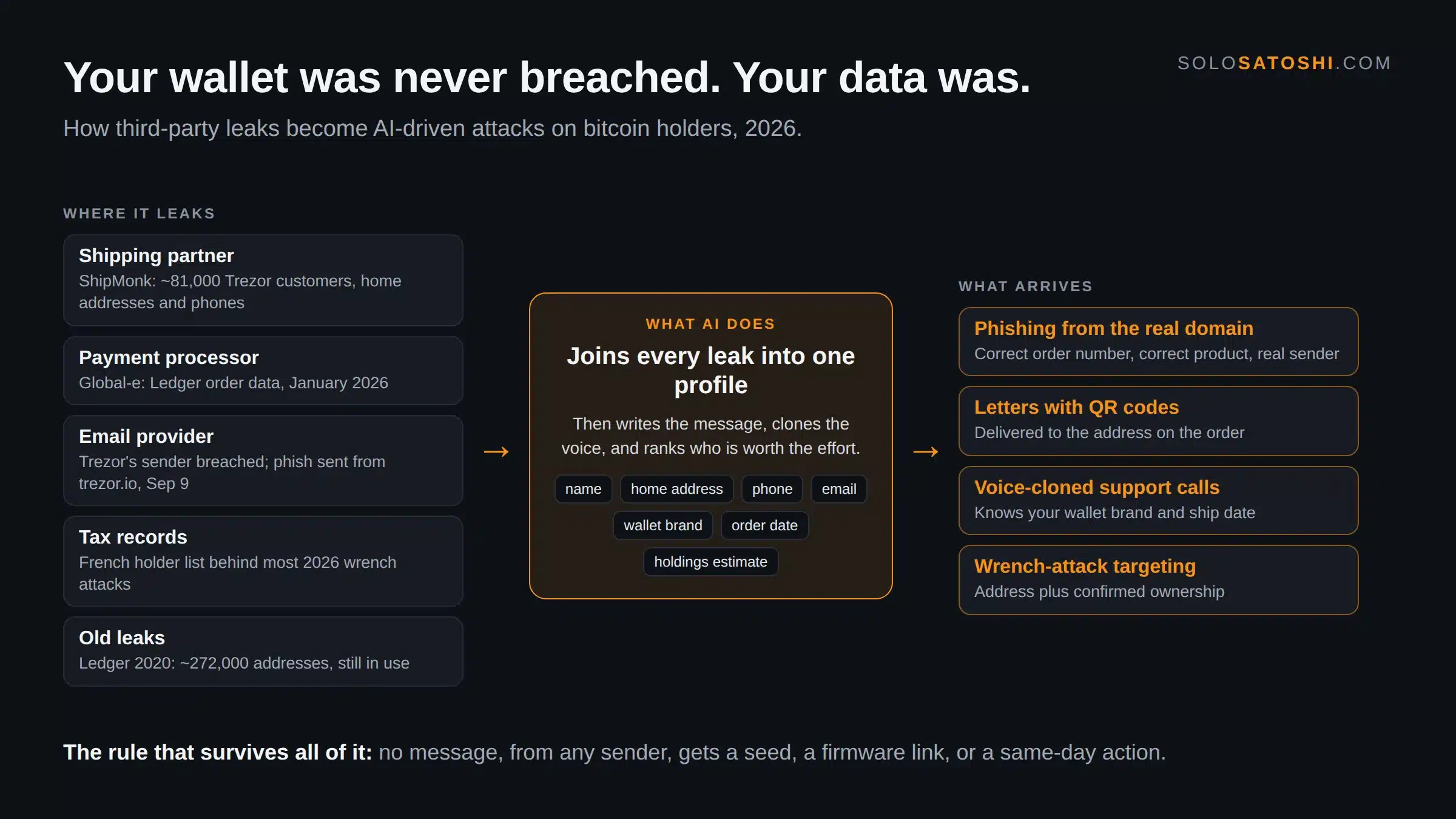
ShipMonk: why “we deleted it” is not a control
Trezor’s shipping provider was breached in early August. The initial disclosure covered 13,689 recent customers and credited Trezor’s 90-day retention rule for limiting the damage.
Then on September 2, ShipMonk told Trezor the breach also held order data from 2019 to 2021, roughly 67,000 more US customers. Trezor says it had repeatedly requested, and received in writing, confirmation that this data was deleted. ShipMonk holds SOC 2 Type II certification. Within weeks, affected customers were reporting phishing calls and physical letters with QR codes at the addresses tied to their orders.
The lesson is not “Trezor was careless.” Trezor had the right policy and the right contract. The lesson is that every company you give your address to keeps it as long as they feel like, certifications do not change that, and a leaked address tied to confirmed bitcoin ownership never expires.
The email-provider breach: when the phish comes from the real domain
Today’s incident is the more dangerous pattern. Trezor disclosed that a third-party email provider was compromised, letting attackers send phishing from Trezor’s legitimate domain. The subject line was “Critical Security Alert: STM32 Entropy Vulnerability.”
The sender checks out. The subject references a real class of bug from a real incident five weeks earlier. The only tell is the ask. Sender verification and “I know what their emails look like” both fail when the vendor’s own sending infrastructure is what got breached.
The defense has to be a rule that does not depend on the message: no email, from any sender, ever gets a seed phrase, a click on a firmware link, or a same-day action.
Are bitcoin miners and bitcoin nodes exposed too?
Yes, but the stakes differ. A miner or node holds no keys. A bug there costs you privacy, uptime, or hashrate, not your bitcoin, unless you have wired it to something that does hold keys.
Some bitcoin miners run open-source firmware with a browser dashboard meant for your home network. A bitcoin node runs Bitcoin Core and the Electrum server your wallet talks to. Both are open source and network-connected, which is exactly the code AI bug hunters are reading now. The realistic risks: someone reaching the dashboard, redirecting your hashrate to a scam pool, or a compromised node lying to your wallet about balances and fees.
Three rules cover it:
- Never port-forward a miner or node dashboard to the internet. Use Tor or a VPN for remote access.
- Update firmware only from the project’s official GitHub releases, and check the signature or hash when one is published.
- Keep miners on a separate network segment from the computer you sign with, so a bug on a $60 device cannot become a foothold next to your keys.
Running your own node is still a net gain. It stops your wallet app from sending every address you own to a company server that can leak like any other third party.
How to stay safe: step by step
These assume the basics from our protection guide are in place: a hardware wallet, steel backups, and on-device address checks. Each step below adds a layer against the two threats above.
- Generate every new seed with your own entropy. 99 rolls of a d6, 23 throws of a d16/d8 set, or 23 draws from Entropia tablets. It is the only defense against an RNG bug nobody has found yet.
- Prefer a signer with nothing to leak. The SeedSigner+ stores no seed, has no radios, and forgets everything at power-off. For stored-seed devices like the Blockstream Jade or Passport Prime, keep firmware current from the maker’s site.
- Treat every firmware notice as hostile until verified at the source. Type the vendor’s URL yourself. A real advisory is on their site and verified socials, never only in your inbox.
- Use a dedicated email for bitcoin, locked with a passkey or hardware key. Every exchange and vendor resets passwords through email. SMS and app codes are routinely bypassed by live phishing proxies; passkeys are not.
- Ship hardware somewhere other than the home your keys live in. PO box, business address, or parcel locker. If you already shipped home, assume that address is in a database and keep keys and steel off-site.
- Set one verification rule for every unsolicited contact. Hang up or close it, wait, and reach the company through a channel you typed yourself. A live deepfake cannot survive a callback to a number you already had.
- Keep AI agents away from your keys. No chatbot or trading agent gets wallet control, an xpub, or the ability to build transactions you sign without reading. Verify addresses on the device screen, never on a screen the AI touched.
- Run watch-only on your own node. No third-party server should ever learn which addresses are yours. It is one less database to leak.
- Migrate any seed from a known-affected device now. A passphrase reduces exposure; it does not repair a weak seed.
- Assume your data has already leaked, and shrink what the next leak adds. Close unused accounts, ask retailers to purge order history, and stop mentioning what you hold anywhere that links to your name.

Bottom line
AI has not broken bitcoin. It has industrialized the two things that were always the real threats: bugs in the code around your keys, and people who know enough about you to lie convincingly. The defenses have not changed much either. They have just stopped being optional.
Build every seed with your own entropy so no vendor’s random number generator can betray you. Use a signer that holds nothing. Give the world as little data as possible, and assume what you have already given is in a spreadsheet somewhere. And let no message, however real it looks or wherever it came from, move you to act today.
The honest trade-off is friction: dice take ten minutes, a PO box costs a little, callbacks feel rude. That friction is now the difference between the people who lost bitcoin in 2026 and the people who did not.
Related reading
- How to Protect Your Bitcoin in 2026: A Practical Guide
- Seed Phrase Entropy Explained: Dice, Tablets, and Your Keys
- Bitcoin Wallets 101: An In-Depth Look
- Bitcoin Node: Why Run One? 8 Benefits, Requirements, and Set Up
- What Are Scam Mining Pools and Why Are They Targeting Home Miners?
Can AI crack a bitcoin private key or seed phrase?
Is my hardware wallet vulnerable to the Coldcard bug?
Should I stop using open-source wallets now that AI can read the code?
How do I know if a security email from my wallet manufacturer is real?
What data does a hardware wallet retailer actually have on me?
Are AI-generated phishing emails really that hard to spot?
Is it safer to leave bitcoin on an exchange until this settles?
Can AI find the seed phrase in a photo on my phone?
Do I need to worry about AI attacks if I only hold a small amount of bitcoin?
Is it safe to ask ChatGPT or another AI assistant for help with my wallet?