Yes. No federal law prohibits individuals from mining Bitcoin, and federal agencies treat it as a lawful activity that comes with tax and reporting consequences. State and local rules vary, and your lease, HOA, city noise rules and wiring can still limit what you run at home.
Federal agencies set rules around mining rather than banning it. The IRS treats mined bitcoin as income, and FinCEN says a person who mines for their own use is not a money transmitter. Some states go further: Montana and Arkansas, for example, stop local governments from banning home mining.
What can still stop you is closer to home: a lease, an HOA, a city noise rule or a circuit that cannot carry the load.
Last checked: November 4, 2026. This guide is general information, not legal advice. For your own situation, talk to a local attorney or a CPA.
New to Bitcoin mining? Our guide to how Bitcoin mining works covers the basics first.
Quick answer: is Bitcoin mining legal for a home miner?
- Federal: mining is allowed, and mined bitcoin is taxable income on the day you receive it (IRS Notice 2014-21).
- License: FinCEN says mining for your own use does not make you a money services business, so there is no federal MSB registration for it.
- States: Montana and Arkansas bar cities and counties from banning home mining. The Texas mining law only covers sites above 75 megawatts.
- Home rules: noise ordinances, HOA covenants and your lease can still limit what you run and where.
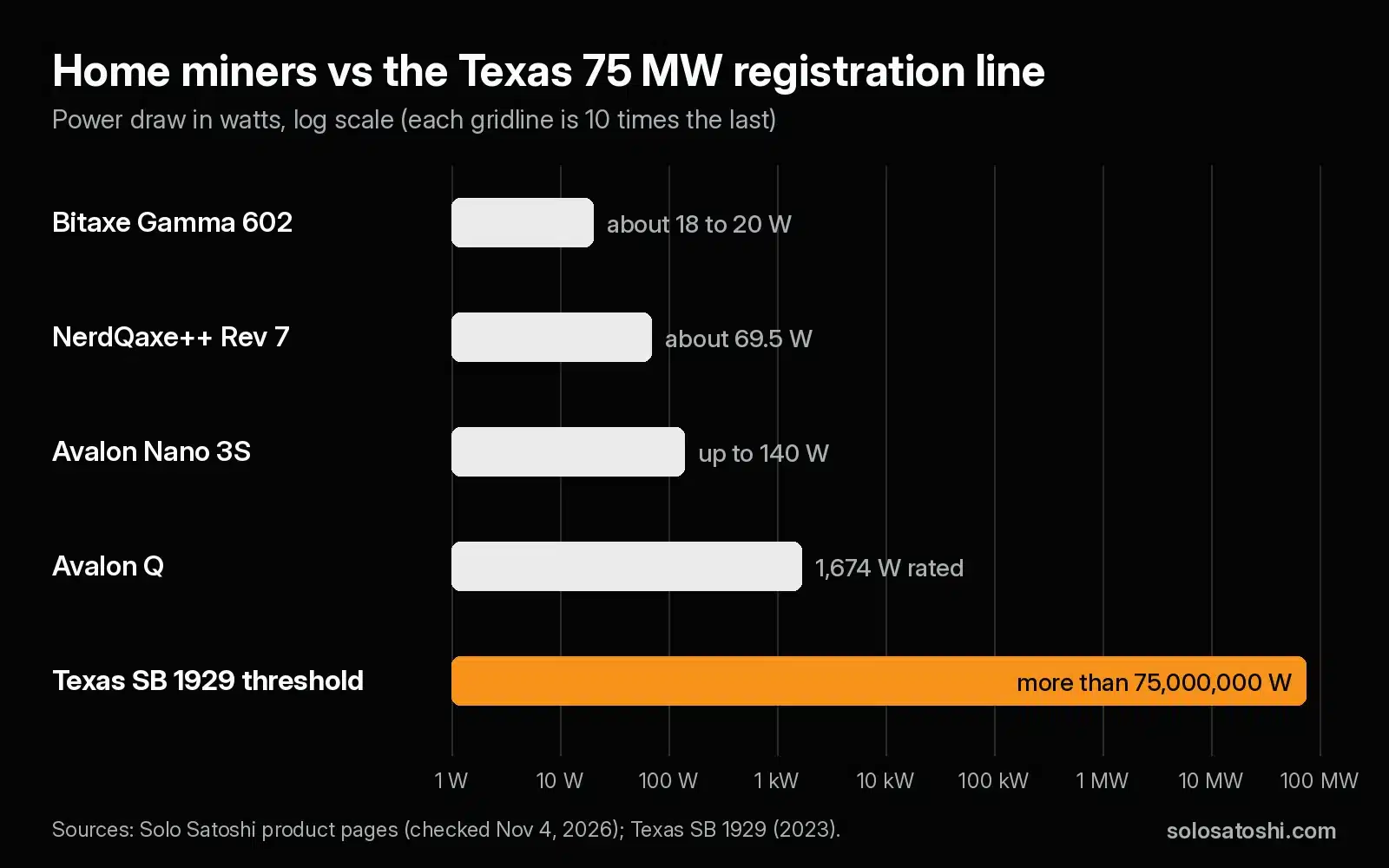
- Scale: a Bitaxe Gamma 602 draws about 18 to 20 W. The Texas registration line starts above 75,000,000 W.
Is Bitcoin mining legal in the United States?
Yes. Federal agencies treat mining as a lawful activity with tax and regulatory consequences. The IRS explains how to report mined coins, and FinCEN explains when mining does and does not bring money transmitter rules into play.
The rules that make the news are about industrial sites: warehouse farms that draw megawatts, lean on the local grid or sit next to a power plant. A home miner is a different animal. The Bitaxe Gamma 602, for example, lists a stock draw of about 18 to 20 W on its product page. That is roughly what a busy phone charger pulls.
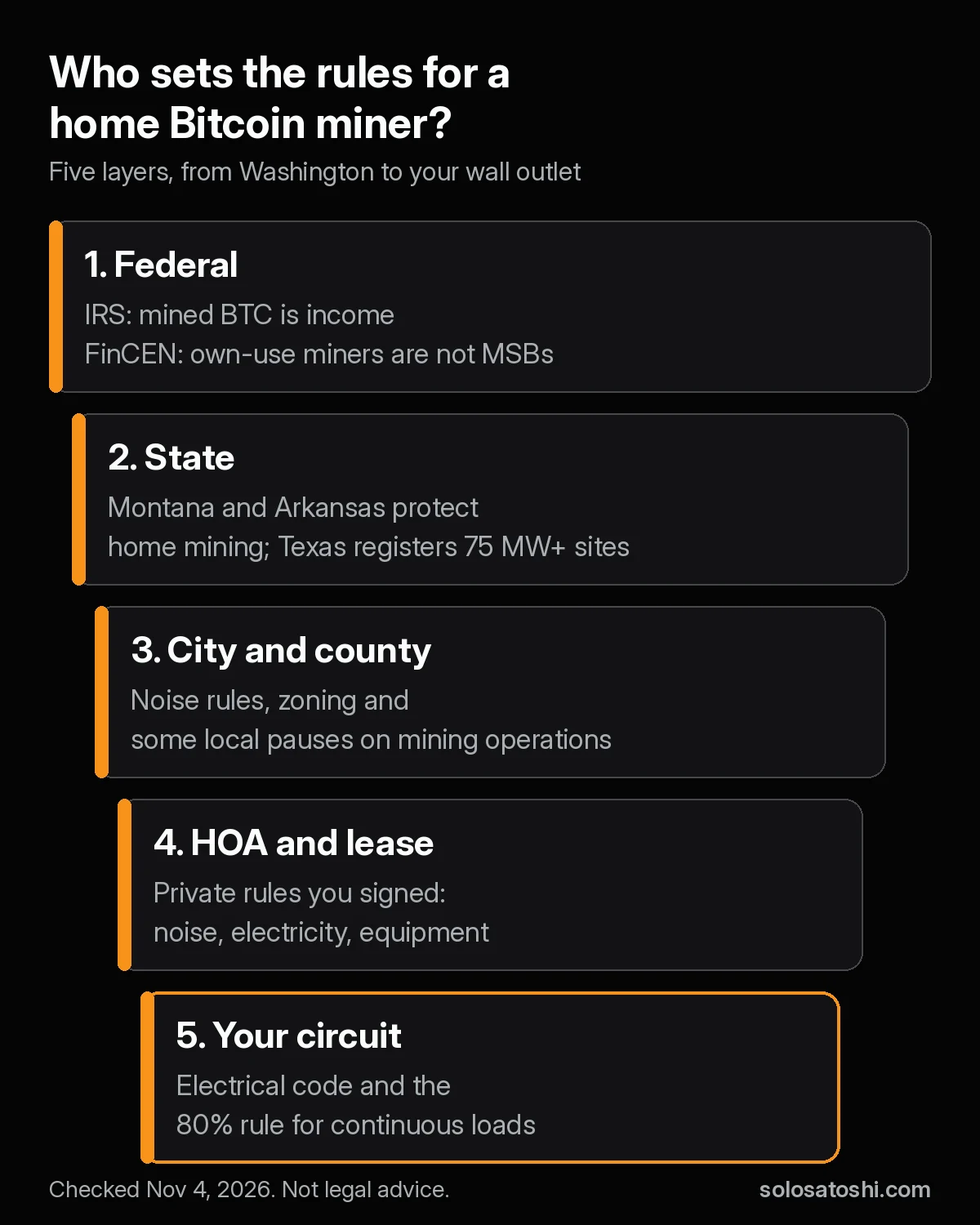
So the useful question for a home miner is not “is this allowed?” but “which rules reach my house?” They come in five layers.
Do you need a license to mine Bitcoin at home?
Not at the federal level for mining your own coins. In a 2014 administrative ruling, FinCEN ruling FIN-2014-R001 said that a person who mines Bitcoin and uses it solely for their own purposes, and not for the benefit of another, is not a money services business under its regulations.
FinCEN restated the same framework in its 2019 guidance, FIN-2019-G001. What matters is what you do with the coins, not whether you mined or bought them. For pools and cloud miners, simply distributing rewards to members is not money transmission, but a leader or cloud miner that combines mining or rental services with hosting wallets for its members is a money transmitter. Pointing one miner at a pool with your own payout address is on the user side of that line, but FinCEN has not addressed that exact setup.
States run their own money transmitter laws, and some have written home miners out of them on purpose. For example, Arkansas Act 851 of 2023 says a person engaged in home digital asset mining shall not be considered a money transmitter under the state Uniform Money Services Act.
Which US states have rules that matter to home miners?
Several states have mining-specific laws; this table covers four we verified against the statute text on November 4, 2026. They either protect home mining or aim at large commercial sites. This table covers only those verified laws; it is not a full 50-state survey.
| State | What the law says | What it means at home |
|---|---|---|
| Montana | Mont. Code Ann. 76-2-1003 (2023): a city, town or county may not adopt a rule that prevents home digital asset mining at a private residence, except as related to existing noise ordinances. | Local bans on home mining are off the table. Existing noise ordinances still apply. |
| Arkansas | Act 851 (2023), amended by Act 173 (2024): a local government may not pass an ordinance that bans home digital asset mining or requires approval for it. Act 173 also added noise rules for mining businesses. | No local ban or permit for home mining. Commercial mining sites face noise rules. |
| Texas | Utilities Code §39.360 (added by SB 1929, 2023): a mining facility in the ERCOT region must register with the PUC if it requires a total load of more than 75 MW and interruptible, and report its location and anticipated demand for five years. | Written for industrial sites. A desk miner is nowhere near the line. |
| New York | New York Environmental Conservation Law 19-0331 (2022): a two-year pause (Nov 22, 2022 to Nov 22, 2024) on new air permits, and on renewals that would increase power use, for carbon-fueled power plants that supply behind-the-meter power to proof-of-work mining. The pause has expired, and a 2025 bill to extend it did not pass. It was aimed at power plants feeding mining operations, not at home miners. | Never aimed at home miners, and no longer in effect. |
| Other states | Many states introduce digital asset bills each year. | Check your state, then your city. |
Where each row comes from:
- Montana: the statute text at Montana Code 76-2-1003.
- Arkansas: Act 173 of 2024, approved May 3, 2024, which amends the 2023 Data Centers Act.
- Texas: Utilities Code §39.360 (added by SB 1929), from the enrolled text of Texas SB 1929, effective September 1, 2023.
- New York: Environmental Conservation Law 19-0331 (expired Nov 22, 2024).
- Other states: the NCSL digital assets legislation tracker, which counted at least 40 states with digital asset bills in the 2025 session.
Is Bitcoin mining legal in Texas?
Yes. The Texas statute written for crypto mining, SB 1929, covers facilities in the ERCOT power region with a total load of more than 75 megawatts and interruptible. Those sites must register with the Public Utility Commission and report their location and anticipated demand for five years. The rule is in Utilities Code §39.360 (added by SB 1929). It took effect on September 1, 2023.
For scale, 75 megawatts is 75,000,000 watts. A Bitaxe Gamma 602 at about 20 W is less than one millionth of that, and so is a NerdQaxe++ at about 69.5 W.
We are based in Conroe, TX, and every order ships from here. If you are local, read about our Conroe, TX storefront and local pickup. Texas home miners still answer to city noise rules, HOA covenants and their lease, the same as anyone else.
What can still limit a home miner? HOA, lease, noise and wiring
Legal at the federal and state level does not mean allowed in every home. Four local things decide most real cases.
- Your lease. Look for rules on equipment, electricity use or running a business from the unit. If utilities are included in your rent, ask the landlord in writing before you plug in.
- Your HOA. Covenants often cover noise, nuisance and home businesses. A quiet desk miner is easier to live with than a loud unit in the garage, but read the rules before you buy.
- City and county rules. Noise ordinances apply to miners like any other appliance, and some towns have paused new mining operations. A Congressional Research Service report lists Plattsburgh, New York (March 2018 to March 2019) and North Tonawanda, New York (adopted July 2024 and extended in 2026) as examples of moratoria on new crypto mining operations.
- Your circuit. A miner is a continuous load that runs all day. Size it with the 80% rule for home mining power, and if you wire a bare 5V supply, follow our Mean Well power supply guide step by step.
When renters ask us about mining at home, we tell them to read the lease and talk to the landlord first. A desk miner like a Bitaxe draws about as much as a phone charger, while a bigger unit needs a proper circuit. Start small and quiet, then grow from there.
Matt, owner of Solo Satoshi (Conroe, TX)
Does the size of the miner change the answer?
Size does not change whether mining is legal, but it changes which rules you will ever meet. State laws and utilities focus on big loads. At home, the real limits are noise, heat and your circuit.
Here is what four home miners draw at stock settings, from each product page on November 4, 2026. Prices can change, so the product page is the final word.
| Miner | Stock power | Published noise | From |
|---|---|---|---|
| Bitaxe Gamma 602 | About 18 to 20 W | Not published | $61 |
| NerdQaxe++ Rev 7 | About 69.5 W | Not published | $189.99 |
| Avalon Nano 3S | Up to 140 W, three power levels | 30 to 40 dB | $219 |
| Avalon Q | 1,674 W rated | 45 to 65 dB | $1,349 |
Want a number for your own setup? Plug the wattage into the power consumption calculator to see daily and monthly kWh.
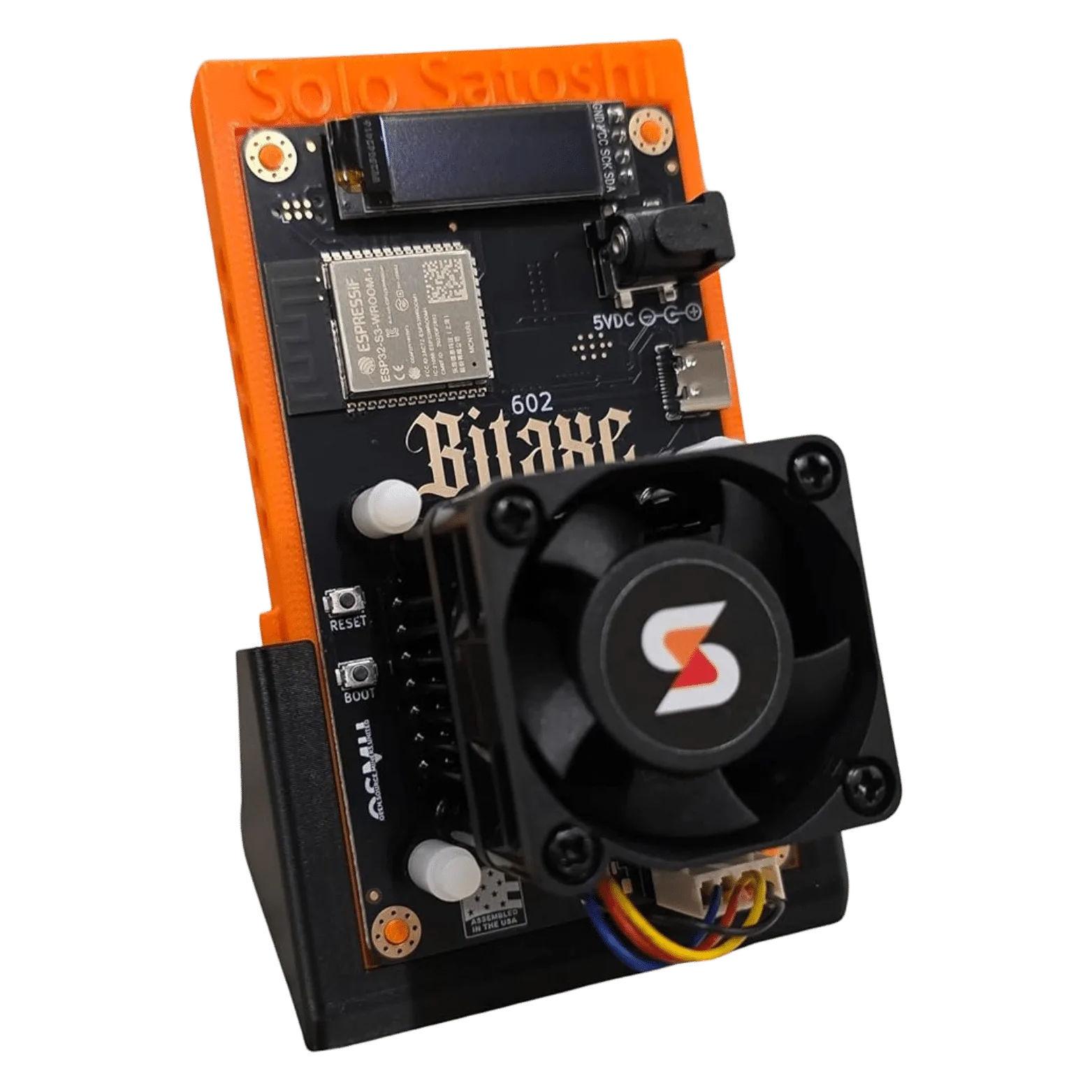
Bitaxe Gamma 602: a desk miner on a 5V supply
One Bitmain BM1370 chip, about 1.2 TH/s at 18 to 20 W, and a 5V barrel jack. It is open-source hardware, runs AxeOS and fits beside a keyboard, which makes it the lowest-stakes way to try home mining.
 View Bitaxe Gamma 602
Avalon Nano 3S: a quiet pick for apartments
Canaan rates it at 6 TH/s and 140 W maximum, with Low, Medium and High power levels in the Avalon Family app. The published noise range is 30 to 40 dB, and Canaan measured 30 dB in Low mode at 25°C. It ships with a 140W GaN power adapter and can warm a nearby desk area.
 View Avalon Nano 3S
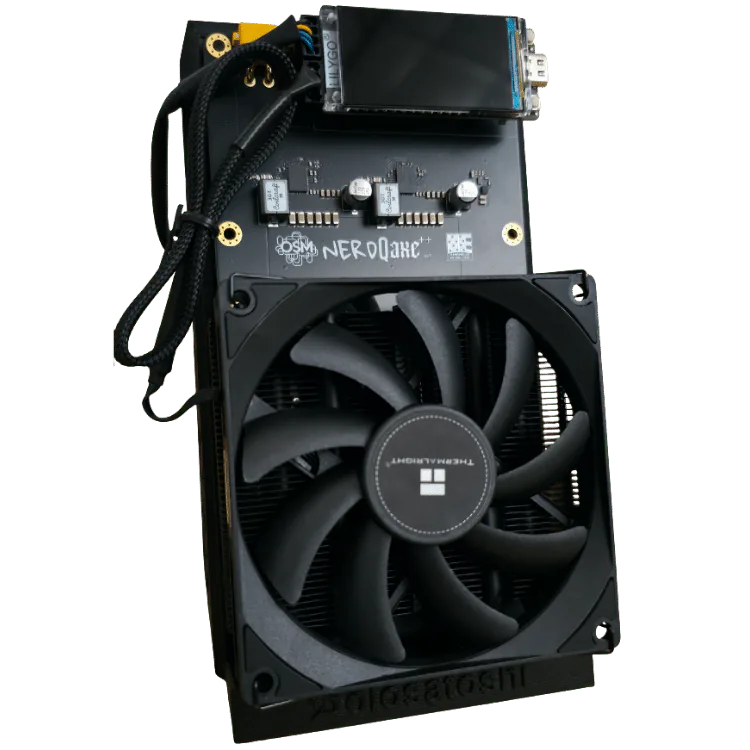
NerdQaxe++ Rev 7: a bigger home miner on 12V
Four BM1370 chips, about 4.8 TH/s at about 69.5 W at stock, and a 12V XT30 input. It is still a desk-sized board, but it needs a proper 12V supply and some airflow around it.
 View NerdQaxe++ Rev 7
How does the IRS treat mined Bitcoin?
As income. IRS Notice 2014-21 says that when you successfully mine virtual currency, its fair market value on the date you receive it is included in your gross income. If the mining is a trade or business, the notice adds, the net earnings can also be subject to self-employment tax.
The IRS digital assets page lists mining among the activities that mean answering “Yes” to the digital asset question on Form 1040, and points to Schedule 1 for reporting this kind of income. The IRS treats digital assets as property, so selling or spending mined coins later is a separate taxable event.
Keep a simple record of the date and dollar value of anything you receive, and ask a CPA how it applies to you. We do not give tax advice.
Is Bitcoin mining legal in other countries?
It depends on the country, and the rules change. Some countries have restricted or banned crypto mining, while others license it or tax it like any other business. Wikipedia keeps a sourced country-by-country overview of crypto legality; treat it as a starting point and confirm with a local attorney before you plug anything in.
This guide covers the United States only, and we do not keep a country table because it would go stale.
Legal is not the same as safe
Legal home mining still attracts scams: pools that skim hashrate, fake miners and tampered firmware. Learn how to spot a scam pool before you point a miner anywhere.
Every miner we ship is bench-tested at our shop in Conroe, TX: we power it on, confirm it hashes, check temperatures, and verify the firmware version before it leaves.
Before you plug in: home mining checklist
Most problems with home mining are not legal ones. They are a buzzing fan, a warm closet or a tripped breaker. Save this list and run through it before the first power-on.
Before you plug in: home mining checklist
- ☐ Read your lease. Look for rules on equipment and electricity use, and ask the landlord in writing if it is unclear.
- ☐ Check your HOA covenants for noise, nuisance and home business rules.
- ☐ Check your city noise ordinance hours, and pick a spot where the fan will not bother housemates or neighbors. Small Bitaxe fans speed up as they warm, so a cooler room is usually a quieter one.
- ☐ Confirm the circuit and outlet rating. Add up everything else on that circuit and keep the continuous load within the 80% rule. Plug into the wall, never into daisy-chained power strips.
- ☐ Use the right power supply. Use the supply the miner was built for, and keep open-frame supplies in an enclosure.
- ☐ Plan ventilation and heat. Nearly every watt ends up as heat: a 140 W miner warms a desk area, and a 1,674 W miner puts out about as much heat as a full-size space heater. Leave space around the intake and exhaust, keep it off carpet and away from curtains, and dust it now and then.
- ☐ Know your power rate so you can see what the miner adds to your bill.
- ☐ Keep a record of mined coins for taxes, with the date and value of anything you receive.
For the rest of the setup, from pool address to first share, follow our step-by-step guide to start mining.
Frequently asked questions
Short answers to the legal questions we get most from home miners.
Is Bitcoin mining legal in Texas?
Do I need a license to mine Bitcoin?
Can I mine Bitcoin in an apartment?
Can my landlord or HOA stop me from mining?
Is mining with a Bitaxe taxable?
Is a USB miner legal?
Is solo mining legal?
Is it legal to mine Bitcoin from another country?
Ready to mine at home?
For most people in the US the legal side is short. The planning goes into the practical side: a quiet spot, a safe circuit and a miner sized for the room.
If you are choosing your first home miner, our guide to the best Bitcoin miners under $500 compares the options side by side.
See the best miners under $500
Legal sources were last checked on November 4, 2026, against the statutes, rulings and agency pages linked above. Laws change, and this page is general information, not legal advice.
Prices, power and noise figures come from Solo Satoshi product pages on November 4, 2026. The product pages are the final word.