Solo Satoshi sells the NerdQaxe++ but does not sell the Hammer Miner BC04. This comparison combines our NerdQaxe++ testing with published manufacturer and reseller information; we identify the sources and where the BC04 has advantages.
The Hammer Miner BC04 and the NerdQaxe++ Revision 7 are both four-chip home miners that start at about 4.8 TH/s. The BC04 reached buyers about a month before Rev 7, but the NerdQaxe++ platform is about 19 months older.
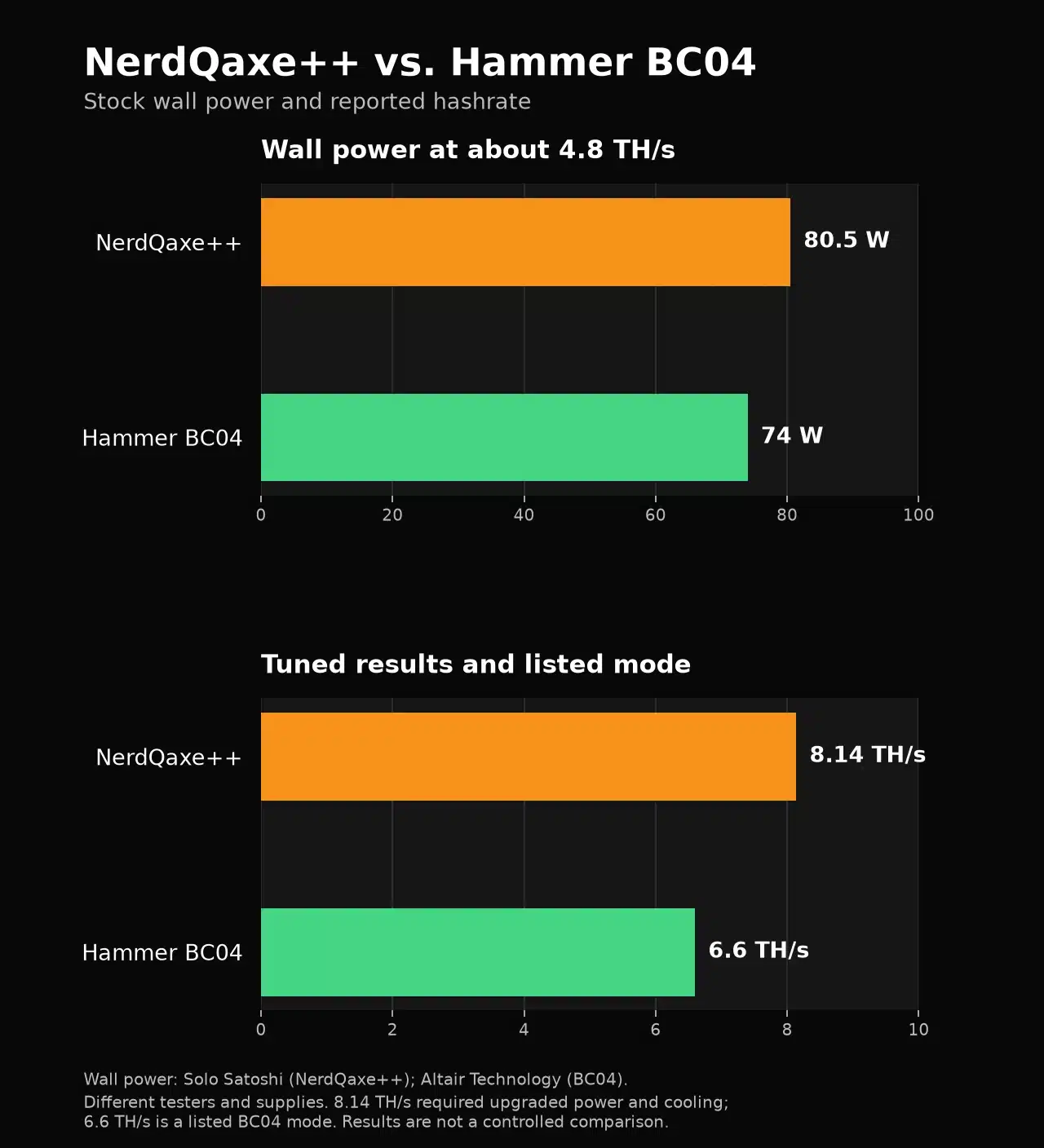
At roughly 4.8 TH/s, our NerdQaxe++ test measured 80.5 W at the wall; Altair Technology reported 74 W at the wall for the BC04. The tests used different setups. The BC04 has built-in Ethernet. The NerdQaxe++ has open firmware, open hardware and a higher tested hashrate than the BC04’s highest published mode (last updated: November 5, 2026). Our Revision 7 breakdown covers the board itself.
Quick answer: Hammer Miner BC04 or NerdQaxe++?
- Chips: both use four Bitmain BM1370 ASICs, both run at about 4.8 TH/s in their lowest stock mode, and both can mine solo or join a payout pool; neither approach guarantees a profit.
- Dates: the BC04’s first public firmware release was May 8, 2026 (build dated April 9). The NerdQaxe++ hardware dates to October 2024, and Revision 7 was announced June 4, 2026.
- Which came first: the NerdQaxe++ (open hardware and GPL firmware from 2024). A README written in the voice of Hammer’s R&D team says the BC04’s earlier firmware contained code derived from ESP Miner, the open-source Bitaxe firmware that the NerdQaxe++ firmware is also built on.
- Where the BC04 wins: built-in Ethernet (useful in a weak Wi-Fi spot, a small edge elsewhere) and a 240 W power supply in the box. At about 4.8 TH/s, our NerdQaxe++ drew 80.5 W at the wall; Altair reported 74 W for the BC04. Different testers and power supplies make this an indicative comparison, not a controlled test. The NerdQaxe++ arrives assembled; customers can select a compatible power supply or choose an upgraded supply from Solo Satoshi.
- Where the NerdQaxe++ wins: 8.14 TH/s in our test with upgraded power and cooling, compared with the BC04’s highest published mode of 6.6 TH/s, open-source firmware and open hardware, and a US-assembled unit from $189.99 with support in Conroe, TX. As of November 4, 2026, you can read the source of its firmware.
- Our pick: the NerdQaxe++ for anyone who wants room to tune, source they can read and ongoing firmware updates. The BC04 is a fair pick if a built-in Ethernet port matters most and you do not need to read the firmware source.
How do the Hammer Miner BC04 and the NerdQaxe++ compare on specs?
Both use four BM1370 chips and an XT30 power connector, so the real differences are power, tuning range, connectivity, firmware, price and what comes in the box. Where a maker publishes more than one number, the table shows the range and the footnote says why.
| Spec | NerdQaxe++ Rev 7 | Hammer Miner BC04 |
|---|---|---|
| ASIC chips | 4x Bitmain BM1370 | 4x Bitmain BM1370 |
| Lowest stock mode | About 4.8 TH/s at 69.5 W (14.48 J/TH), +/-15% | 4.8 TH/s at 76 W, 32 dB (Altair Technology listing) |
| Higher modes | 5.7 TH/s at 82 W (700 MHz), 8.14 TH/s at 142.4 W (1000 MHz), our tests | 6 TH/s at 97 W, then 6.6 TH/s at 108 W (Altair Technology listing) |
| Wall power at about 4.8 TH/s | 80.5 W at the wall (Solo Satoshi test) | 74 W at the wall (Altair Technology report) |
| Connectivity | 2.4 GHz Wi-Fi, plus Ethernet through a separate add-on board (firmware v1.1.1 or newer) | 2.4 GHz Wi-Fi and built-in RJ45 Ethernet |
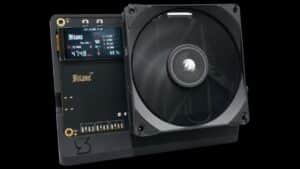
| Display | 1.9 inch LilyGO color LCD | Color screen with several pages (Altair lists AMOLED) |
| Cooling | Thermalright AXP90-X36 heatsink and fan, optional 80 mm Noctua rear fan | Heatsink and fan, published only as “dual cooling” |
| Noise | Approximately 36 dB at default settings in a quiet room, measured at 3 ft (0.91 m) | 32 to 40 dB depending on page and mode |
| Power supply | Optional 12.4 V, 10 A, 124 W unit | 240 W (12 V, 20 A) included by Altair Technology |
| Firmware | Nerd*OS, open source (GPL-3.0) | Thor OS, binary releases only |
| Hardware design | Open (CERN-OHL-S-2.0) | No design files published (we found none) |
| Size and weight | 3.54 x 4.72 x 1.57 in, about 0.8 lb with heatsink | Hammer lists two different sets, see note |
| Warranty | 6-month limited warranty from Solo Satoshi, from original delivery (earlier purchases included) | 6-month limited (Hammer’s service page) |
| Price | From $189.99 | About $210 to $349.99 at online sellers |
Sources: our NerdQaxe++ product page and benchmark tests, the official Hammer BC04 page, Hammer’s firmware release notes and US reseller listings, Public pages were read on November 4, 2026; our wall-power test is dated November 5, 2026. Hammer’s own pages disagree with each other: the BC04 page says 200 x 150 x 80 mm, 1.5 kg and under 35 dB, while its comparison table says 6.5 x 3.75 x 1.81 in, 406 g and 40 dB. Wall-power figures come from our NerdQaxe++ test and Altair Technology’s BC04 comparison; different test conditions and power supplies affect the result. The supply label states 124 W; 99.2 W is an 80% operating target, not a separate manufacturer rating.
How much does each miner cost?
The prices overlap once you count the power supply. The NerdQaxe++ is $189.99 without a power supply and $210.99 with our North American 124 W unit. We saw the BC04 at about $210 to $349.99 across four online sellers in early November 2026, each with a power supply included.
- NerdQaxe++ Rev 7: $189.99 board only, $210.99 with the power supply, $217.99 with power supply and stand, $237.99 with power supply, stand and Noctua rear fan (from our store, November 4, 2026).
- Hammer Miner BC04: prices of about $210, $215, $299 and $349.99 at four online sellers, each listing a power supply (read November 4, 2026).
Price per TH/s with a power supply
Price per TH/s divides the purchase price by the selected hashrate. At the same approximately 4.8 TH/s setting, the two prices are close. Both can run around 6 TH/s using their respective power supplies: the NerdQaxe++ with tuning and the BC04 in its listed overclock mode. Higher settings change power use and results vary. Prices below were checked November 5, 2026.
| Miner and setting | Price with PSU | Hashrate | Price per TH/s |
|---|---|---|---|
| NerdQaxe++ Rev 7, listed stock | $210.99 | 4.8 TH/s | $43.96/TH |
| NerdQaxe++ Rev 7, tuned with stock PSU | $210.99 | ~6.0 TH/s | $35.17/TH |
| Hammer BC04, listed normal mode | $215.00 | 4.8 TH/s | $44.79/TH |
| Hammer BC04, listed overclock mode | $215.00 | 6.0 TH/s | $35.83/TH |
The NerdQaxe++ price includes the North American supply and no optional stand or rear fan. The tuned ~6 TH/s configuration can run on that stock supply at around 97 W, according to our supplied result; settings and results vary. The measurement point for that 97 W figure has not been documented, so it is not directly compared with the supply output rating. This is separate from our published 6.1 TH/s benchmark, which used a Mean Well supply and an additional rear fan. Altair Technology’s BC04 listing includes a supply and stand. Figures exclude shipping, tax, electricity, and other operating costs. Results vary by mode and unit; price per TH/s is not a profitability estimate. Prices and availability can change.
Verdict: which miner should you buy?
Choose the NerdQaxe++ for open hardware and firmware, tested overclocking headroom, and support from Solo Satoshi. Customers can select a compatible power supply when ordering or choose an upgraded supply; wall-power efficiency varies with the power supply used. Choose the BC04 if built-in Ethernet and the included power supply are priorities.
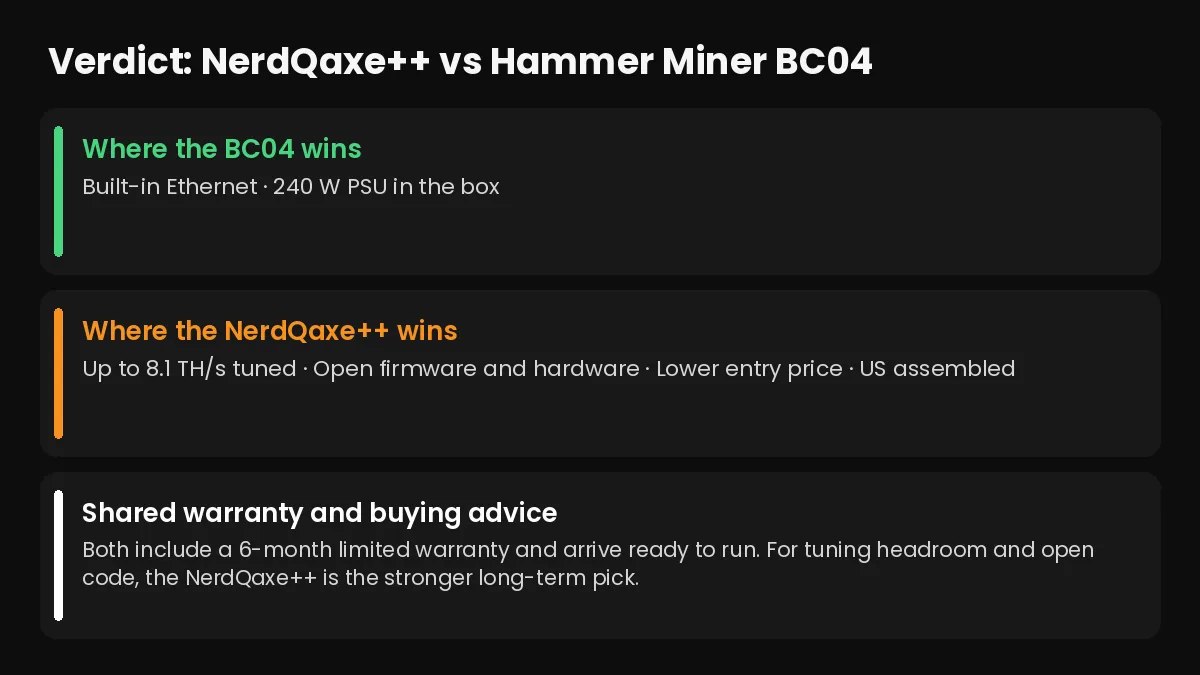
Both can mine solo or join a payout pool. Solo block discovery is uncertain; pools distribute payouts according to their own rules. Estimate solo odds with the solo odds calculator.
Which one uses less power, the BC04 or the NerdQaxe++?
At approximately 4.8 TH/s, our NerdQaxe++ test measured 80.5 W at the wall. Altair Technology reported 74 W at the wall for the BC04 at 4.8 TH/s. The BC04 reading is 6.5 W lower, but these tests were conducted by different testers using different power supplies and conditions; they are not a controlled side-by-side comparison.
What does the difference cost? If both miners ran 24 hours a day for 30 days at these readings, the 6.5 W difference would be 4.68 kWh, or about $0.56 per month at $0.12 per kWh. Your electricity rate and actual uptime will change the result. The BC04 has the lower calculated wall-power use in these reported results, but power-supply efficiency may contribute to the gap; the separate tests do not establish how much it contributes.
For context, the NerdQaxe++ product listing reports approximately 69.5 W of device power at 4.8 TH/s. That listing figure is separate from the 80.5 W wall reading, which includes power-supply losses. Because the listing and wall readings are not paired 24-hour measurements from the same test, their difference does not establish the power-supply loss. Power supplies vary in efficiency.
Altair does not disclose every BC04 test condition. See the testing record below for what we know and what is missing. To estimate electricity cost, use wall power in our power consumption calculator.
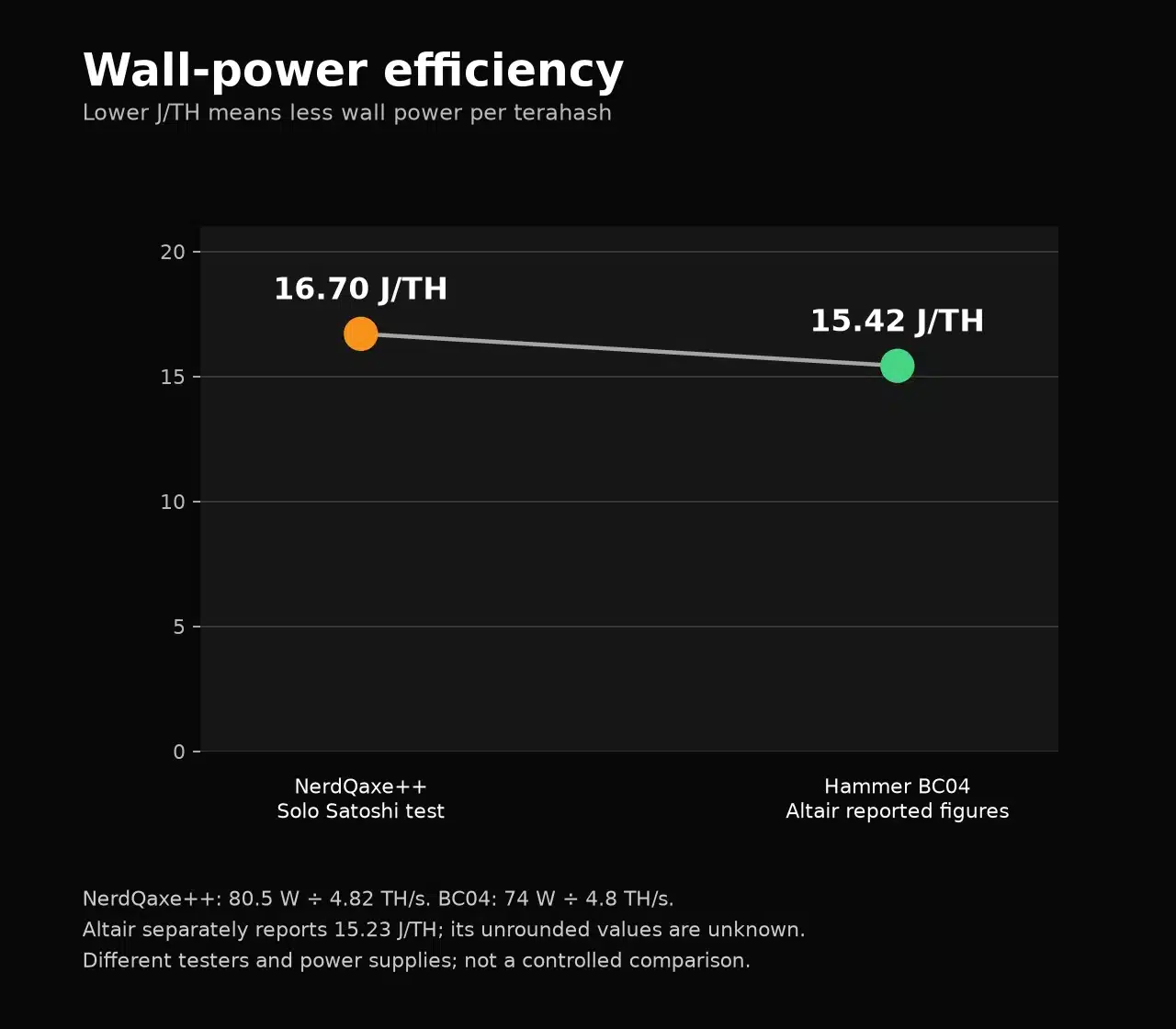
Using wall power and hashrate, our NerdQaxe++ result calculates to 16.70 J/TH (80.5 W ÷ 4.82 TH/s). Altair’s rounded BC04 figures calculate to 15.42 J/TH (74 W ÷ 4.8 TH/s); Altair separately reports 15.23 J/TH. Different testers and power supplies mean these are not controlled side-by-side results.
Testing method and measurement record
The BC04 column uses Altair Technology’s published comparison. Its 74 W figure is a wall-power reading, not device-reported DC power. N/A means the detail was not reported in the comparison. The NerdQaxe++ column shows Solo Satoshi test details and identifies product-listing figures separately.
| Test detail | NerdQaxe++ Revision 7 | Hammer Miner BC04 |
|---|---|---|
| Test date and location | November 5, 2026; Solo Satoshi shop, Conroe, Texas | N/A |
| Tester / source | Solo Satoshi | Altair Technology, published comparison |
| Board model and revision | NerdQaxe++ Revision 7 | Hammer Miner BC04; board revision not stated |
| Firmware version | Nerd*OS v1.1.1 (confirmed) | N/A |
| Tested profile: factory default or manual settings | Factory settings | Described as stock; settings and test setup not fully documented |
| Configured frequency (MHz) | 600 MHz | 600 MHz in comparison; 500 MHz in listing for 4.8 TH/s (conflict) |
| Configured core voltage (mV) | 1,200 mV | N/A for comparison test; listing gives 4.6 V for normal mode (measurement point unspecified) |
| PSU model and output voltage | Sunshine, 12.4 V, 10 A, 124 W (label rating) | Listing includes 12 V / 20 A (240 W); model used in test not stated |
| Cooling hardware and fan settings | Stock heatsink and fan; automatic fan control, approximately 40% | Listing describes dual cooling; test fan settings not stated |
| Ambient temperature (°C) | 20.6°C (69°F) | N/A |
| Noise level (dB) | Approximately 36 dB at default settings in a quiet room, measured at 3 ft (0.91 m) | 32 dB in normal mode (Altair product listing; measurement conditions not stated) |
| Power measurement source / device-reported DC basis | Device-reported power | Wall power reported; meter and device-reported DC power not stated |
| Warm-up / settling time | 2-hour warm-up; 1-hour settling time | N/A |
| Measurement duration and averaging window | 24 hours | N/A |
| Average hashrate (TH/s) | 4.82 TH/s (24-hour average) | 4.8 TH/s reported; averaging period not stated |
| Average device power (W) | Approximately 69.5 W (listed stock device power) | N/A |
| Wall power (W), as reported | 80.5 W at the wall (24-hour average) | 74 W at the wall |
| Calculated efficiency (J/TH) | 16.70 J/TH at the wall (80.5 W ÷ 4.82 TH/s); 14.48 J/TH device power is the product-listing figure | 15.23 J/TH at the wall reported by Altair; 74 W ÷ 4.8 TH/s equals approximately 15.42 J/TH |
Altair’s published settings differ: Its comparison gives 600 MHz at 4.8 TH/s, while its BC04 product listing gives 500 MHz for the same hashrate. The listing also gives 4.6 V, but does not identify the measurement point clearly enough to compare it directly with the NerdQaxe++ core-voltage setting. We have not resolved these discrepancies.
Which is faster, and how far can each miner go?
The NerdQaxe++ goes further. Hammer’s modes, as a reseller lists them, top out at 6.6 TH/s at 108 W, while we ran a NerdQaxe++ at 8.14 TH/s for 17 hours and 42 minutes at 142.4 W. That result needed an upgraded power supply and a rear fan.
Out of the box the two are close. The BC04’s V2.0.1 release note sets its factory-restore default to overclock mode, and Rabid Mining’s stock-firmware test ran at about 6 TH/s. The NerdQaxe++ starts at 4.8 TH/s and leaves the choice to you.
The catch with the NerdQaxe++ is the power supply. The optional supply is labeled 124 W. Using 80% of that figure gives a conservative operating target of 99.2 W, not a manufacturer-stated continuous rating. Higher-power overclocking, including our approximately 140 W result, requires a suitably rated higher-capacity supply and adequate cooling. The BC04 listing includes a larger power supply; its highest published mode is 6.6 TH/s. Our NerdQaxe++ overclocking guide lists every step.
Which is quieter, and which is easier to set up?
The NerdQaxe++ measured approximately 36 dB at default settings from 3 ft (0.91 m) in a quiet room. Altair lists 32 dB for the BC04 in normal mode. Altair does not specify its measurement distance or conditions, so these figures do not establish which is quieter. The BC04 also offers wired setup through Ethernet. Hammer’s pages list 32 to 40 dB, while Bitcoin Almanack’s Rev 7 review calls the NerdQaxe++ cooling audible. We found no calibrated independent decibel test for either.
- Noise: published BC04 figures are 32 dB (normal mode), 34 dB and 36 dB (higher modes) on a reseller page, under 35 dB on Hammer’s product page and 40 dB on its comparison table. The NerdQaxe++ fan runs at approximately 40 percent in our stock test and 100 percent at 1000 MHz.
- Setup: both start their own Wi-Fi network for first-time setup. The NerdQaxe++ takes about five minutes with our NerdQaxe++ setup guide. A reseller’s BC04 guide shows a similar flow, and the BC04 can also use its Ethernet port.
- In the box: a US BC04 reseller lists the miner, a stand, a 240 W power supply and cords. Our NerdQaxe++ ships assembled, and the power supply, stand and rear fan are options.
Does Ethernet matter for a solo or lottery miner?
Ethernet does not increase the ASICs’ hashrate, but a reliable connection keeps the miner supplied with current work and helps it submit shares. Weak Wi-Fi, network interruptions, and delayed jobs can reduce effective mining time; a wired connection may help where Wi-Fi is unreliable.
The BC04 has Ethernet built in. The NerdQaxe++ uses 2.4 GHz Wi-Fi and supports a separate W5500 Ethernet HAT with firmware v1.1.1 or newer; see the Ethernet support changes. A stable Wi-Fi connection can also work well for mining.
Both platforms have received connectivity fixes: an ESP-Miner issue documents a Wi-Fi interruption, and Hammer lists an Ethernet fix in its BC04 release notes. Monitor uptime and rejected or stale shares when evaluating either connection.
Is the Hammer Miner BC04 open source like the NerdQaxe++?
The NerdQaxe++ runs open-source Nerd*OS firmware under GPL-3.0 on hardware licensed CERN-OHL-S-2.0. The BC04’s current Thor OS is distributed as compiled firmware; as of November 4, 2026, we found no published source tree for that system.
- NerdQaxe++: the Nerd*OS firmware source in the shufps repository and Revision 7 hardware design files are public. Version 1.1.0 added solo-mining verification, and v1.1.1 added Ethernet HAT support, according to the release notes.
- BC04: current compiled updates are available through the HammerMiner releases. Source for an earlier pre-production firmware is published separately.
How mature is the firmware?
The NerdQaxe++ runs Nerd*OS, whose public firmware repository dates to August 2024 and builds on the longer-running ESP-Miner project. Its source code, issue history, changes, and release notes are available for users to inspect. The broader project history is older than Revision 7 support itself.
Hammer’s BC04 firmware releases have a shorter public history, beginning in 2026. Hammer has published updates addressing issues including Ethernet, restarts, and pool compatibility. A separate repository contains source described as earlier firmware; it should not be confused with the current Thor OS release.
Nerd*OS therefore has a longer public development history and gives owners more visibility into its code. That history alone does not prove either miner will be more reliable in every setup.
Earlier BC04 firmware and ESP-Miner attribution
The baichuan-org/BC04 README, written in the voice of the Hammer R&D team, says an outsourced pre-production firmware incorporated code derived from ESP Miner. It describes that source release as fulfilling GPL obligations and says it will not be maintained. ESP Miner is also part of the NerdQaxe++ firmware’s open-source ancestry.
The same README describes later systems, including Thor OS, as a separate clean-room effort. We have not audited Thor OS source and cannot independently verify that account. The earlier code release should not be presented as source for the current firmware.
Open source lets a user inspect how the firmware calculates reported hashrate and handles mining work. With either miner, compare dashboard figures with pool-side results over a suitable period. Our open-source firmware article and AxeOS guide explain those checks.
For access control, Nerd*OS release notes describe an OTP option for the local interface, while a BC04 reseller’s setup guide says its dashboard opens without a login. Keep either device on a trusted network.
When did the NerdQaxe++ and the Hammer Miner BC04 come out?
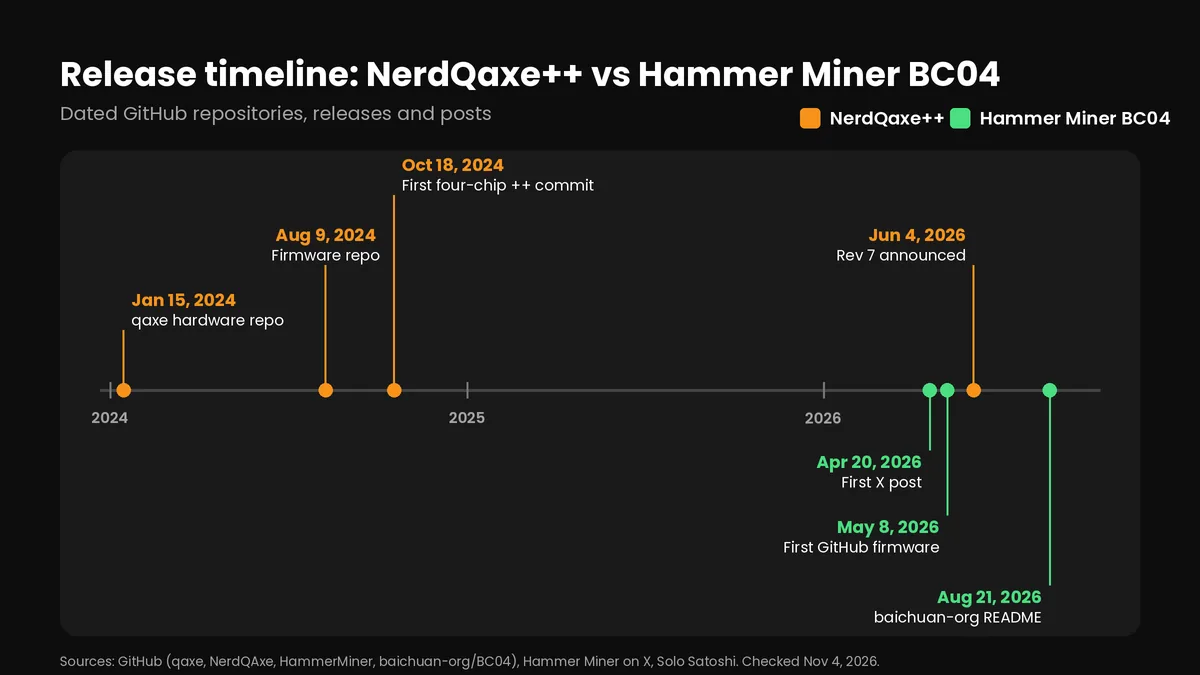
The NerdQaxe++ is the older platform: its open hardware repository dates to January 2024 and the four-chip design to October 2024. The Hammer Miner BC04 is newer, with its first public firmware release on May 8, 2026, and it reached US buyers in June 2026.
Neither maker publishes a clean launch announcement, so each date below comes from a repository, a release page or a dated post, and carries a confidence level.
NerdQaxe++ release timeline
| Date | What happened | Confidence |
|---|---|---|
| Jan 15, 2024 | The open-hardware qaxe repository is created on GitHub (CERN-OHL-S-2.0 license). | High (GitHub) |
| Aug 9, 2024 | The NerdQAxe firmware repository is created, under the GPL-3.0 license. | High (GitHub) |
| Oct 18, 2024 | First commit for the four-chip NerdQaxe++ hardware in the qaxe repository. | High (GitHub) |
| Jun 4, 2026 | Solo Satoshi announces Revision 7, with the TPS546D24A two-phase power stage from the Bitaxe GT. | High (our own post) |
| Jun 15, 2026 | Rev 7 support is merged into the firmware (pull request 628). | High (GitHub) |
| Mid to late Jun 2026 | Rev 7 units start shipping from Solo Satoshi. | Medium (our dated posts on X) |
| Aug 29, 2026 | Firmware v1.1.0 adds first-class Rev 7 support and solo-mining verification. | High (GitHub release) |
| Oct 31, 2026 | Firmware v1.1.1 adds support for an Ethernet HAT on the NerdQaxe++. | High (GitHub release) |
Hammer Miner BC04 release timeline
| Date | What happened | Confidence |
|---|---|---|
| Apr 9, 2026 | Build date in the name of the first official firmware, V2.0.0-20260409 (“the first officially released version”). | High for the build date |
| Apr 20, 2026 | Hammer Miner’s first post about the BC04 on X. | High (dated post) |
| May 8, 2026 | That firmware is published on the HammerMiner GitHub, and the BC04 repositories are created the same day. | High (GitHub) |
| Mid May 2026 | Hammer posts about customer units and early reviews appear. | Medium (dated posts) |
| Jun 2026 | US resellers list the BC04. One reseller review is dated June 15, 2026. | Medium (retailer pages) |
| Jul 22, 2026 | Firmware V3.0.0 moves the BC04 to the Thor OS base. Resellers say units shipped before July 23 ran the older HammerOS. | High (GitHub), Medium (reseller note) |
| Aug 21, 2026 | A README in the baichuan-org/BC04 repository, written in the voice of “the Hammer R&D team”, accompanies source for an earlier pre-production firmware. It says that code incorporated code derived from ESP Miner. | High (GitHub) |
| Sep 11, 2026 | Firmware V3.0.5 is the latest release we found. | High (GitHub) |
Dates checked on November 4, 2026. We found no preorder date or formal launch announcement for the BC04. One reseller catalogue lists the BC04 under 2025, but we found no repository, post or release from 2025 to support that, so we do not use it.
What the timeline tells you: the BC04 shipped about a month before Revision 7, so it first competed with Rev 6.1. Rev 7 is the answer, a power-delivery redesign on a platform that was already about 19 months old when the BC04 appeared.
Where does the Hammer Miner BC04 really win?
The BC04 includes built-in Ethernet and, from the cited reseller, a 12 V / 20 A power supply. Published noise figures vary by source and mode; without comparable measurements, we cannot establish which miner is quieter.
Where does the NerdQaxe++ win?
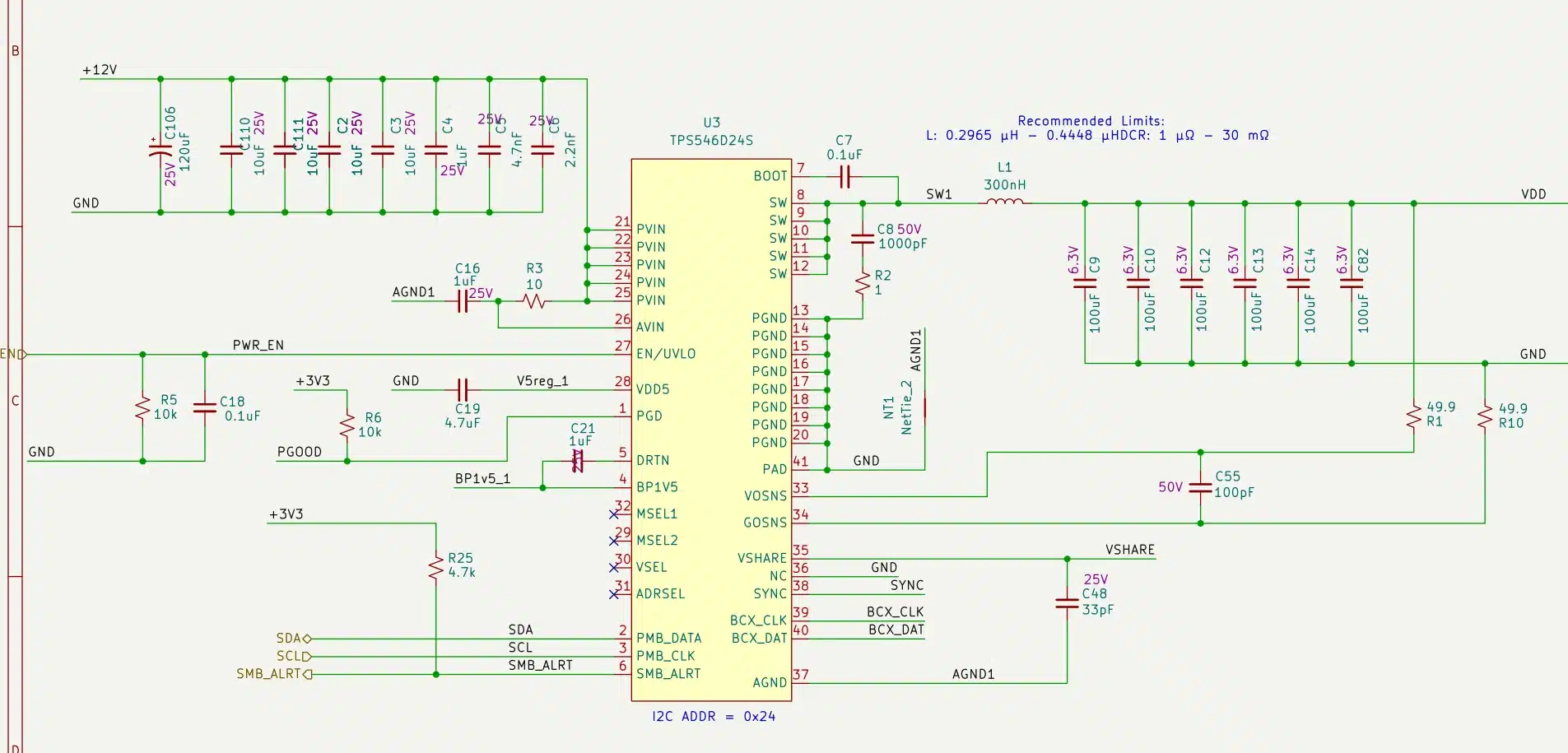
The NerdQaxe++ offers open hardware and firmware, a publicly documented development history, and support from Solo Satoshi. Revision 7 uses a TPS546D24A two-phase power stage. Our test reached 8.14 TH/s with upgraded power and cooling; that is not an out-of-box guarantee. The BC04’s cited 6.6 TH/s is a listed mode, not a verified absolute limit.
What could we not verify?
We have not tested a BC04. Its figures come from the manufacturer, a reseller, or independent testers, not a matched Solo Satoshi bench test. Hammer’s published dimensions, weight, and noise figures differ between pages. We also found no published source code for current Thor OS or a confirmed formal launch date.
Frequently asked questions
When did the Hammer Miner BC04 come out?
When did the NerdQaxe++ come out?
Is the Hammer Miner BC04 better than the NerdQaxe++?
Does the Hammer Miner BC04 use less power than the NerdQaxe++?
Is the Hammer Miner BC04 open source?
Did the BC04 firmware use ESP Miner code?
Does the NerdQaxe++ have Ethernet?
Does Ethernet make a Bitcoin miner faster or improve solo odds?
Which is quieter, the BC04 or the NerdQaxe++?
Can the BC04 or the NerdQaxe++ find a Bitcoin block?
Shop the NerdQaxe++ at Solo Satoshi
If you want the open, tunable miner, the NerdQaxe++ Revision 7 is assembled and tested in the USA and shipped from Conroe, TX. Browse every home lottery miner we sell in the bitcoin lottery miners category.
NerdQaxe++ specifications and prices come from the Solo Satoshi product page and our benchmark tests, checked on November 5, 2026. BC04 figures come from the sources named above, checked on November 4, 2026. Prices and specifications change, so each product page is the final word. Solo mining is a lottery, and no miner is guaranteed to find a block.