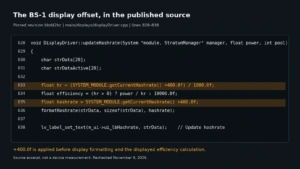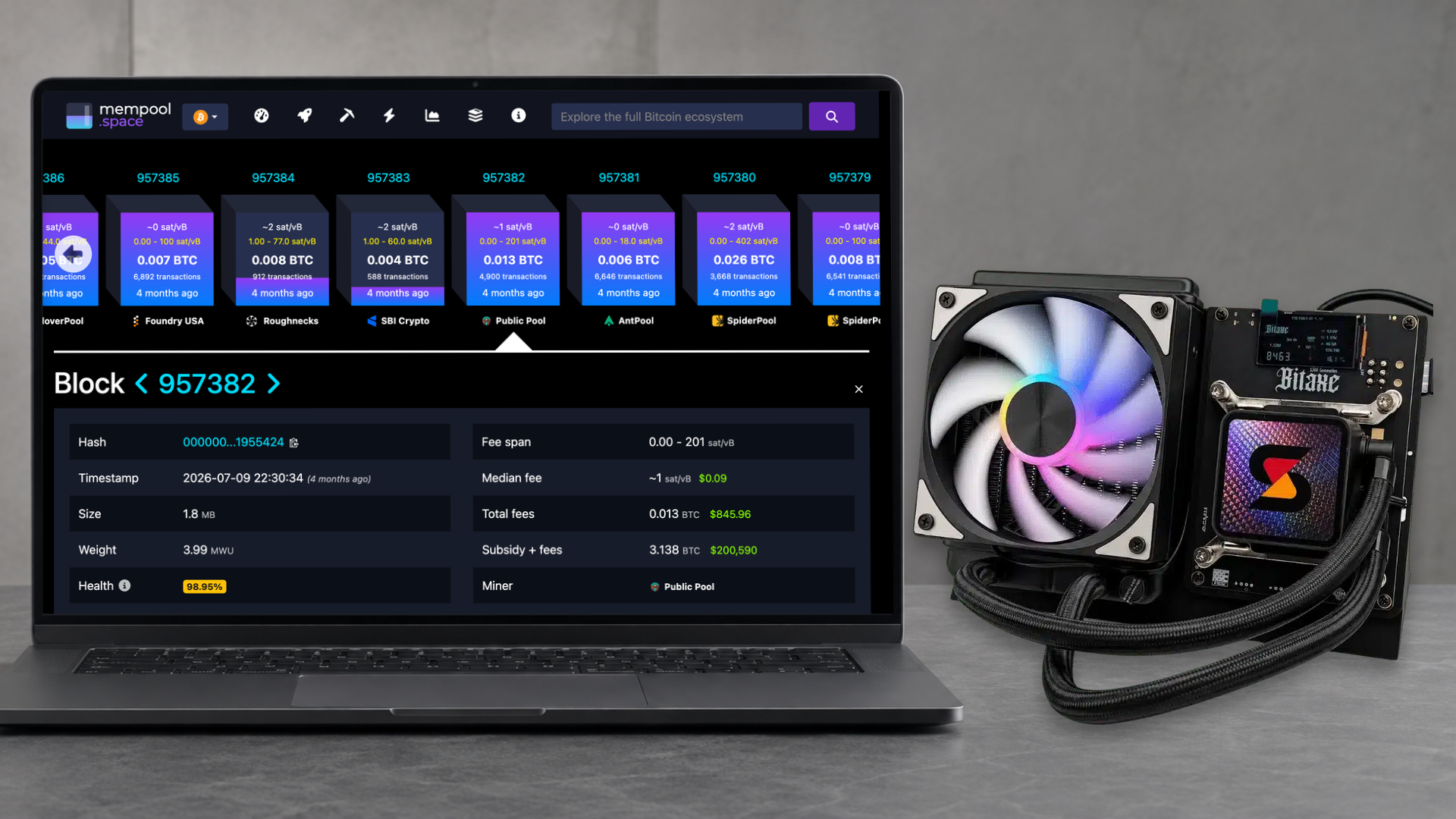
Yes. Bitaxe miners have found accepted Bitcoin blocks, with winning workers documented by Solo CKPool and Public Pool. The block and its payout can be checked on-chain; identifying the physical miner also requires pool logs, owner evidence, or other attributable records.
The cases below separate Bitaxe-related reports from Nerd-family finds, distinguish total block rewards from miner payouts, and explain what those successes mean for your own odds. They show that small miners can submit valid blocks, without making the next win predictable.
Quick overview
- Bitaxe block finds are real: CKPool’s records identify Bitaxe workers at blocks 853,742 and 887,212, while Public Pool records a worker named “bitaxe” at block 957,382. Exact model claims need more evidence than a worker name alone.
- Rewards and payouts differ: a solo miner receives the accepted block’s subsidy and transaction fees, minus any service fee. The OCEAN case was shared-reward pool mining, so the winning device’s owner did not receive the entire reward.
- The historical details matter: the July 2024 account was reporting terahash-level work at the time of its win; block 920,440 involved a reported mixed setup of roughly 130 TH/s. Neither should be presented as a lone small board producing the whole setup’s hashrate.
- More useful work improves probability: sustained hashrate, uptime, current difficulty, and successful submission matter. A high best share or a shorter gap between other people’s wins does not make your next hash more likely to succeed.
- The current example remains a long shot: at the November 9, 2026 difficulty snapshot, continuous 1.2 TH/s has about a 1-in-16,827 chance of at least one block in a year if difficulty stays fixed. The table below compares other rates and explains the assumptions.
- Verify a claimed win in layers: check the accepted block and coinbase outputs, then the pool’s successful submission record, and finally the hardware evidence. If your miner reports a win, confirm it was Bitcoin mainnet and that the payout destination is yours.
What Is a Bitaxe Block Find?
A Bitaxe block find occurs when a Bitaxe’s ASIC produces a block-header hash that meets Bitcoin’s network target and the resulting valid block is accepted into the chain. A blockchain record can confirm the accepted block and its coinbase outputs, but it does not by itself identify the physical miner that found the qualifying hash. The Bitaxe platform combines a mining ASIC, an onboard controller, and network connectivity so a small home device can perform that work.
The hardware does the hashing, while a pool or a self-hosted mining stack supplies jobs and submits a candidate block. Bitcoin’s mining documentation describes those separate roles. A normal accepted pool share is evidence of submitted work; most shares do not meet the much harder Bitcoin block target.
The same device can participate in a solo service or a shared-reward pool. Finding the winning hash does not, by itself, determine how its owner is paid. That depends on the reward arrangement configured before the find.
Documented Bitcoin Blocks at a Glance
The seven records below cover four Bitaxe-related cases and three related Nerd-family reports. This is a sourced selection, not a claim to count every block ever found by open-source home hardware.
Scroll sideways to compare all columns. Keyboard users can focus the table and use the arrow keys.
| Block and date | Reported hardware or worker | Reward record | Service |
|---|---|---|---|
| 853,742July 24, 2024 | Worker named “bitaxe”; account roughly 3 TH/s in the operator’s short-window readings. Exact model not established by that log. | 3.19249143 BTC total; 3.12864161 BTC to the miner after the service fee. | Solo CKPool |
| 887,212March 10, 2025 | “bitaxeultra4” worker, roughly 480–490 GH/s; account about 3.3 TH/s. | 3.15016555 BTC total; 3.08716224 BTC to the miner. | Solo CKPool |
| 913,272September 5, 2025 | NerdQaxe++ reported through OCEAN/DATUM; the reported device reference was about 4.8 TH/s. | 3.13410405 BTC coinbase total distributed across multiple outputs; shared-reward pool case. | OCEAN |
| 920,440October 23, 2025 | Customer-reported NerdQaxe++ Rev. 6 cluster plus an Avalon miner; roughly 130 TH/s combined. | 3.14115228 BTC to the coinbase’s paying output. | Self-hosted Public Pool |
| 924,569November 21, 2025 | Gamma-like reported worker; operator log shows about 1.23 TH/s for that worker and 6.13 TH/s for the account’s one-hour average. | 3.14642595 BTC total; 3.08349744 BTC to the miner. | Solo CKPool |
| 943,466April 3, 2026 | Public Pool entry names worker “NerdOCTAXE.” That entry does not establish the complete physical setup. | 3.14767454 BTC coinbase total. | Public Pool |
| 957,382July 10, 2026 | Public Pool records a worker named “bitaxe” and a successful solo submission. | 3.13823506 BTC coinbase total. | Public Pool |
The numerical reward totals above come from each block’s coinbase outputs. Worker names and hardware descriptions come from the separately identified pool or owner records; they are not device identifiers encoded into the Bitcoin blockchain.
Bitaxe-Related Bitcoin Block Records
Block 853,742: July 24, 2024
Block 853,742 is associated with a worker named “bitaxe” in the CKPool operator’s July 2024 log. The block timestamp is 17:43:43 UTC on July 24, 2024.
The account’s readings are important: the operator’s log shows approximately 3.11 TH/s over five minutes and 1.09 TH/s over an hour, while its daily average was 473 GH/s. Those windows describe different periods. Quoting only the smaller daily reading as the instantaneous size of the winning setup misrepresents the available record.
The log identifies the worker, but does not establish a particular Bitaxe board model or prove that only one physical miner was connected. A Bitaxe Supra specification cannot settle that historical identity. The defensible conclusion is the pool’s reported Bitaxe-worker attribution, together with the independently checkable block and payout.
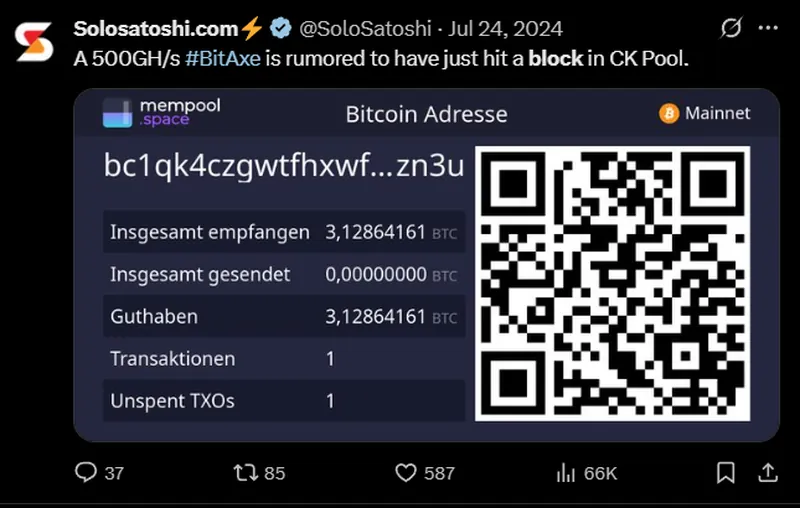
The coinbase transaction paid 3.12864161 BTC to the miner and 0.06384982 BTC to CKPool’s fee address, from a total of 3.19249143 BTC. The difference between that total and the 3.125 BTC subsidy was transaction fees.
Block 887,212: March 10, 2025
The CKPool operator’s March 2025 log names the winning worker “bitaxeultra4,” operating at roughly 480–490 GH/s, within an account hashing at about 3.3 TH/s. This is a stronger worker-level attribution than an unexplained screenshot of a high best share.
Solo Satoshi’s contemporary post describes six Bitaxe units. The operator’s own figures distinguish the individual winning worker from the account total: its one-hour readings were about 492 GH/s and 3.35 TH/s, respectively. The cluster’s total work matters when estimating the account’s probability.
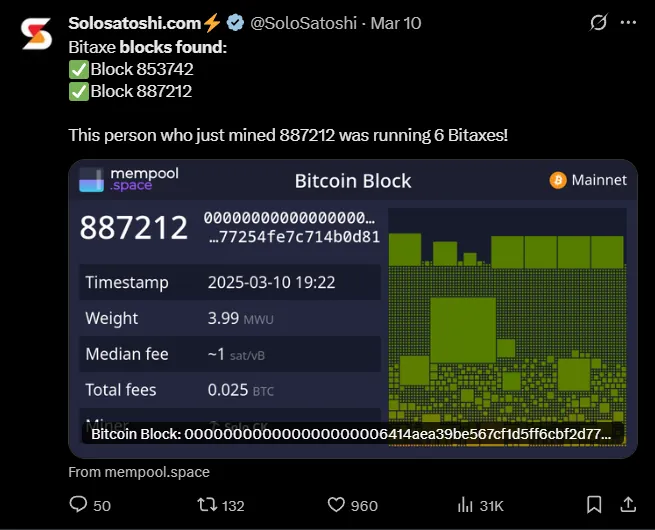
The coinbase outputs total 3.15016555 BTC, including 3.08716224 BTC to the miner and 0.06300331 BTC to the fee address. Neither the dollar value nor the time since a previous Bitaxe report changes what those outputs establish.
Block 924,569: November 21, 2025
The CKPool operator’s November 2025 log records a worker at about 1.23 TH/s over an hour and the account at about 6.13 TH/s over the same window. That performance is consistent with Gamma-class hardware, but the log alone does not verify a Gamma 602 model or an exact count of physical units.
The successful share’s difficulty was approximately 221.39 trillion, exceeding the block’s network difficulty of approximately 152.27 trillion. This is evidence of a successful result for that job, not a progress score that helped the miner become due for a win.
The coinbase transaction contains 3.14642595 BTC in total, with 3.08349744 BTC paid to the miner and 0.06292851 BTC to CKPool’s fee address. The miner’s payout being below 3.125 BTC is explained by the service fee applying to the combined subsidy and transaction fees.
Block 957,382: July 10, 2026
Public Pool’s found-block records include block 957,382, a worker named “bitaxe,” and a successful solo block submission. The chain records the block at 03:30:34 UTC on July 10, 2026, with a 3.13823506 BTC coinbase total.
The pool’s entry supports its worker attribution. It does not, on its own, identify the exact model, firmware settings, cooling package, or complete setup hashrate. Keep those distinctions when comparing this case with reports of a single Gamma or a multi-device cluster.
Related Nerd-Family Block Finds
Block 913,272: NerdQaxe++ on OCEAN
A NerdQaxe++ was reported as the winning device for block 913,272 on September 5, 2025, while participating in OCEAN’s mining pool. This was shared-reward pool mining, so the device’s owner was not entitled to the entire block reward.
The report describes DATUM template construction with a Start9 home server and Bitcoin node, using a roughly 4.8 TH/s device reference. DATUM lets supported miners construct their own block templates while participating in the pool’s reward arrangement; it does not convert a shared-reward pool into a solo service.
The coinbase transaction totals 3.13410405 BTC and has multiple paying outputs. That record verifies the distribution, while the reported hardware and operating stack belong to the accompanying NerdQaxe++ block-find coverage.
Block 920,440: Customer-Reported Mixed Setup
Block 920,440 was mined on October 23, 2025, with a coinbase paying 3.14115228 BTC to one address. Solo Satoshi’s customer report describes six NerdQaxe++ Revision 6 units and an Avalon miner producing approximately 130 TH/s combined.
The customer contacted Solo Satoshi after the find and reported buying the NerdQaxe++ units from us, with plans to use the proceeds toward his home. That account is meaningful first-hand reporting, but it does not independently establish which physical ASIC submitted the final winning hash.
The coinbase includes the text “Public Pool on Umbrel,” supporting the reported self-hosted infrastructure. A coinbase tag cannot identify the attached hashboards or prove that every component of a mixed setup was open-source hardware. See the customer’s Public Pool block-find story for the report and running a solo setup on Umbrel for the architecture.
Block 943,466: NerdOCTAXE Worker on Public Pool
Public Pool’s found-block list names a “NerdOCTAXE” worker for block 943,466, dated April 3, 2026 on-chain. The coinbase total is 3.14767454 BTC.
This belongs in the broader home-miner history, rather than the Bitaxe-specific count. The entry is a pool record of a worker name; it does not establish all of the owner’s devices, their aggregate hashrate, or an independently inspected hardware configuration.
How Do You Verify a Claimed Bitaxe Block Find?
Verify the accepted block and its coinbase outputs first, then check the pool’s submission record and the evidence identifying the hardware. A blockchain explorer confirms the chain record; it cannot inspect the physical miner that supplied the hash.
Block hash, height, UTC timestamp, coinbase transaction, and paying outputs.
Successful submission, worker identity, job context, and dated account or worker readings.
Owner documentation, identifiable device configuration, and attributable reporting.
Worker names are user-configurable, and hashrate estimates depend on the observation window. A name such as “bitaxe” is useful attribution evidence when published by the operator, but it is not a cryptographic certificate of the board model. A screenshot of an address balance also cannot, by itself, prove who owned the hashing equipment.
Check the blockchain as well as the height. Compatible SHA-256 firmware can mine other chains, and a “block found” message on another network does not establish a Bitcoin mainnet win. Our guide to checking mining-pool warnings and evidence explains why a payout address alone is not proof of the chain being mined.
How Much Does a Miner Receive for Finding a Block?
A successful solo miner receives the accepted block’s subsidy plus its transaction fees, minus any applicable service fee. A device mining through a shared-reward pool receives payment under that pool’s method instead.
The subsidy for the blocks discussed here is 3.125 BTC. Transaction fees vary by block, so the total coinbase reward is not always the same. Solo CKPool publishes a 2% service fee; its historical coinbase transactions above show the separate miner and fee outputs.
For a fee rate f and transaction fees F, the illustrative solo payout is (3.125 + F) × (1 − f) BTC, subject to satoshi rounding and the service’s actual template. Check the coinbase outputs for a particular block instead of substituting a rounded headline figure.
Dollar values need a named valuation time and exchange-rate source. Adding historical headline valuations, or counting OCEAN’s entire coinbase as one device owner’s income, would give a misleading combined payout. The BTC outputs are the durable reference for this history.
What Are Your Chances of Finding a Bitcoin Block?
Your chance depends on the useful hashes you produce against the network target during the period being measured. Past wins, a high best share, and shorter intervals between other miners’ successes do not improve the probability of your next hash.
The example below uses Public Pool’s Bitcoin mainnet network snapshot checked November 9, 2026: difficulty 148.364561 trillion. It assumes continuous useful hashing and unchanged difficulty for a full 365.25-day year. Future difficulty changes, downtime, stale work, and unsuccessful submissions can change actual results.
| Useful hashrate | Chance of at least one block in one year | Mean waiting time | Example context |
|---|---|---|---|
| 1.2 TH/s | About 1 in 16,8270.00594% | About 16,827 years | Small single-device rate |
| 3.3 TH/s | About 1 in 6,1190.01634% | About 6,119 years | Small combined setup |
| 4.8 TH/s | About 1 in 4,2070.02377% | About 4,207 years | Four-chip-class reference |
| 6 TH/s | About 1 in 3,3660.02971% | About 3,365 years | Larger small-miner setup |
| 7.2 TH/s | About 1 in 2,8050.03565% | About 2,804 years | Six times 1.2 TH/s |
| 130 TH/s | About 1 in 1560.64174% | About 155 years | Mixed setup reference |
The mean is not a deadline. Even after one mean waiting period, a fixed-rate model still gives about a 37% chance of no block. That is why lottery mining can produce an exceptional story while remaining overwhelmingly unlikely to pay a small solo miner in a particular year.
Calculation: mean seconds ≈ difficulty × 232 ÷ hashrate in hashes per second. Probability of at least one block in time t ≈ 1 − exp(−t ÷ mean seconds). This is the conventional large-difficulty approximation under fixed conditions.
Keep the units consistent: 1 TH/s = 1,000 GH/s, 1 EH/s = 1,000,000 TH/s, and 1 ZH/s = 1,000,000,000 TH/s. Network hashrate and difficulty are related, but an estimated network hashrate and a fixed-difficulty calculation are not interchangeable snapshots.
The five older reports do not prove an accelerating timetable. Their publication and discovery dates are a selected sample, and total installed hashrate and network difficulty also change. More collective useful work can produce more collective opportunities without making an individual machine due for a reward.
How Can You Improve Your Solo Mining Odds?
Increase useful sustained hashrate and avoid preventable downtime while keeping power, cooling, and pool connectivity reliable. Compare the extra work with its electrical and hardware cost; none of these changes guarantees a block.
- Add hashrate deliberately: six equally productive 1.2 TH/s miners supply six times the hashing work of one over the same interval. The exact probability of at least one block follows the formula above rather than an unlimited “luck multiplier.”
- Keep the miner operating normally: confirm accepted work, suitable power delivery, and stable network access. Bitcoin targets an average ten-minute block interval; it does not provide precisely 144 scheduled chances every day.
- Maintain cooling: check fans, heatsink contact, room conditions, and regulator temperature where available. Our Bitaxe cooling guide explains the practical options.
- Judge tuning by useful results: use the Bitaxe overclocking guide for the relevant board and the NerdQaxe tuning guide for that platform. A higher configured frequency is worthwhile only if sustained useful work improves within the hardware’s limits.
- Choose the service by its actual terms: compare reward method, compatibility, fees, endpoint reliability, and self-hosting responsibilities in our solo mining pool comparison.
Our solo-mining odds calculator models other hashrates and difficulty inputs. The broader mining calculator helps compare operating costs. Treat both as scenario tools, with their assumptions visible, rather than forecasts of when a block will arrive.
What Should You Do if Your Bitaxe Reports a Block?
Confirm the accepted Bitcoin mainnet block and its payout destination before treating the dashboard message as a reward. Save the relevant logs and pool records while they are still available.
- Record the event: keep the block height or hash, timestamp, configured service, worker, and original logs. Avoid making configuration changes before preserving useful records.
- Check the chain: use your trusted Bitcoin node or an established explorer to confirm that the block is accepted on Bitcoin mainnet, rather than another SHA-256 chain or a stale candidate.
- Inspect the coinbase transaction: compare the output address with the receiving destination you control and account for the configured reward method and any service fee.
- Allow for maturity: newly generated coinbase outputs have a 100-block maturity rule before they can be spent. A wallet may display them before they are spendable.
- Protect your keys: no pool or support representative needs your seed phrase or private key to verify a public block. Share public evidence deliberately, and avoid revealing private account or network information.
Related Guides and Hardware
Choose a miner by its actual power requirements, cooling, controls, and supported firmware, rather than a past owner’s block win. A previous successful device does not receive better future odds than another device doing the same useful work.
For current hardware details, compare the Bitaxe Gamma, Gamma Duo 650, Bitaxe GT 801, and NerdQaxe++. Check each listing’s selected configuration and included power supply; this historical article does not attach a fixed sale price to a block-find story.
Readers building their own infrastructure can explore the Start9 Server One and the open-source mining community. Our explanation of solo miners covers the reward model, while the Bitaxe range and broader home-miner selection provide hardware comparisons.
For hardware and setup questions, contact Solo Satoshi through our website. Keep the public block evidence separate from private support information.